Free Worldwide Shipping on Orders Over $150
Hassan of Tamegroute: The Green Glaze of the Desert’s Edge

Drive south from Ouarzazate, past the crumbling kasbahs and the last groves of date palms, and the landscape becomes something elemental. The green disappears. The sky flattens into a sheet of white heat. The road narrows to a single ribbon of asphalt crossing a terrain that is more Mars than Morocco.
And then, just when the Sahara seems to have swallowed everything — every color, every softness, every mercy — you reach Tamegroute. And you see the green.
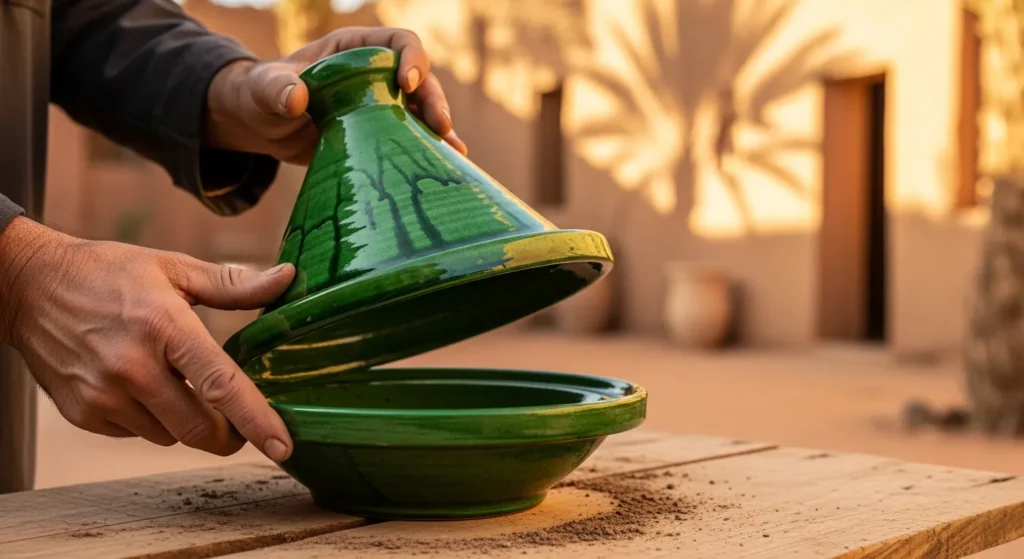
It is unmistakable. In a village made entirely of dust-colored earth — adobe walls, sand streets, a horizon of ochre and tan — the pottery of Tamegroute glows like an oasis. A green so deep and particular it has no equivalent in a paint store or on a color chart. It is not emerald. It is not forest. It is not jade. It is Tamegroute green — a color that has been produced in this village, and only this village, for over 400 years.
Hassan Ait Lahcen, fifty-seven, is one of the last masters of this green. He has been making and glazing Tamegroute pottery since he was fourteen. His hands are permanently stained — not with clay, but with the copper oxide that gives the famous glaze its color. His fingertips are green. His palms are green. Even his nails carry a faint verdant tint that no amount of washing can remove.
“The green is inside me now,” Hassan says, holding up his hands. “After forty-three years, it’s in my skin, in my blood. I am part of the glaze, and the glaze is part of me.”
A Village With One Secret
Tamegroute’s pottery tradition is inseparable from its spiritual history. The village is home to the Zaouia Naciria, a 17th-century Islamic library and religious brotherhood that once served as a center of learning along the trans-Saharan trade routes. It was the scholars and clerics of the zaouia who, centuries ago, encouraged local potters to develop a distinctive glazing technique — partly for functional reasons (glazed pottery held water better in the arid climate) and partly for aesthetic ones (the green was associated with Islam, with paradise, with life in the desert).
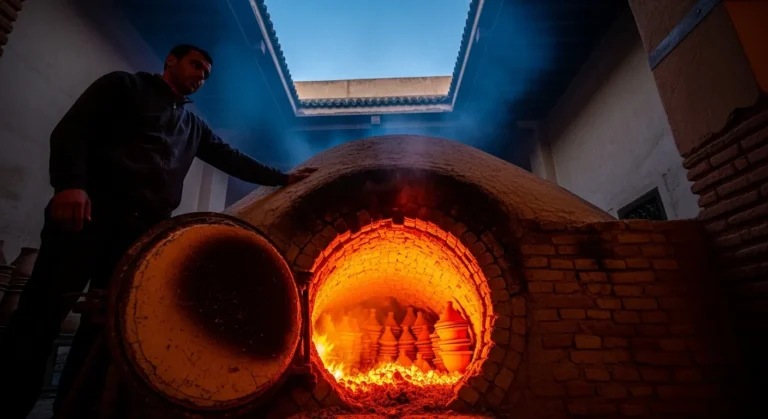
The secret of Tamegroute’s green lies in its glaze formula — a mixture of copper oxide, manganese, silica, and local mineral compounds that are combined in proportions known only to a handful of families. The glaze is applied to the raw clay and fired in a wood-burning kiln, and the chemistry of the firing transforms the mixture into a glass-like surface of extraordinary depth. The green is not uniform; it shifts and pools across the surface, creating variations that range from nearly black to bright celadon, with subtle brown and yellow undertones where the glaze thins over ridges and rims.
“No two pieces are ever the same green,” Hassan says. “The kiln decides the final color. I prepare the glaze, I apply it as evenly as I can — but then the fire takes over. The temperature, the draft, the amount of oxygen in the kiln, even the type of wood I burn that day — all of these change the green. It is never exactly what I expect. That is what makes it beautiful.”
The Boy Who Carried Clay
Hassan did not inherit his craft from his father. His father was a farmer — dates and barley on a small plot irrigated by the ancient khettara water channels that thread beneath the Draa Valley. But the farm could not support a family of eight, and when Hassan was fourteen, his father arranged for him to apprentice with a neighbor, Moha Ould Brahim, who ran one of Tamegroute’s oldest pottery workshops.
“I didn’t want to go,” Hassan admits, with the honesty of a man who has had decades to make peace with his story. “I was a boy. I wanted to play football, to swim in the irrigation channels, to chase lizards. Clay was boring to me. Sitting in a workshop all day while my friends were outside — I hated it at first.”
His early tasks were menial: hauling clay from the riverbed, mixing water and earth in large stone basins, stacking firewood for the kiln. He didn’t touch the wheel for two years. He didn’t touch the glaze for four.
“Moha told me something that I didn’t understand until much later,” Hassan recalls. “‘You are not learning pottery,’ he said. ‘You are learning to see.’ He made me carry the clay because he wanted me to feel how heavy it was, to notice how it changed when it was wet versus dry, to understand that the finished pot was already inside the raw earth. I thought he was just making me do the hard work. He was teaching me the most important lesson.”
By the time Hassan was eighteen, he had earned his place at the wheel. But his real passion, the thing that set his pulse racing, was the glaze.
“The wheel is the body of the tagine,” Hassan says. “But the glaze is its soul.”
Mixing the Green
Hassan’s glaze-making process is closely guarded — not out of secrecy or commercial protectiveness, but out of a deeply held belief that the knowledge is sacred and should be transmitted person-to-person, hand-to-hand, not written down or mass-produced.
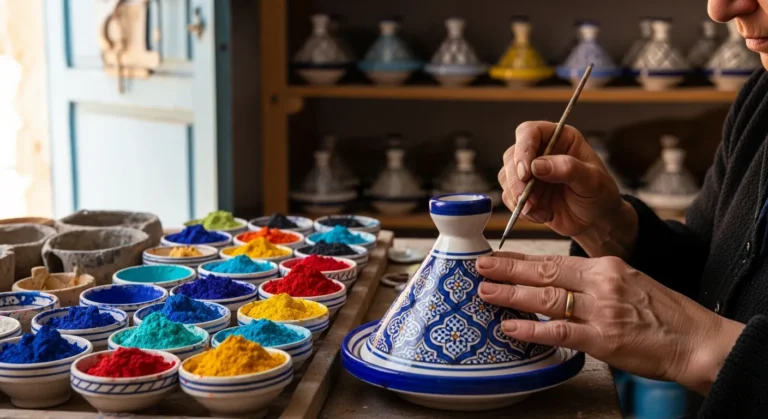
What he will share is this: the base mineral is copper oxide, sourced from deposits in the surrounding mountains. It is ground to a fine powder using a stone mortar — the same type of mortar that has been used in Tamegroute for centuries. The powder is mixed with silica (crushed quartz), a small amount of manganese oxide (which deepens the green and adds brown undertones), and a liquid flux made from wood ash that helps the glaze melt and bond to the clay during firing.
“The proportions are everything,” Hassan says. “A pinch more manganese and the green becomes almost black. A little less copper and it goes pale, like a sick leaf. The right green — the real green — is somewhere in between. Finding it is not science. It is feeling.”
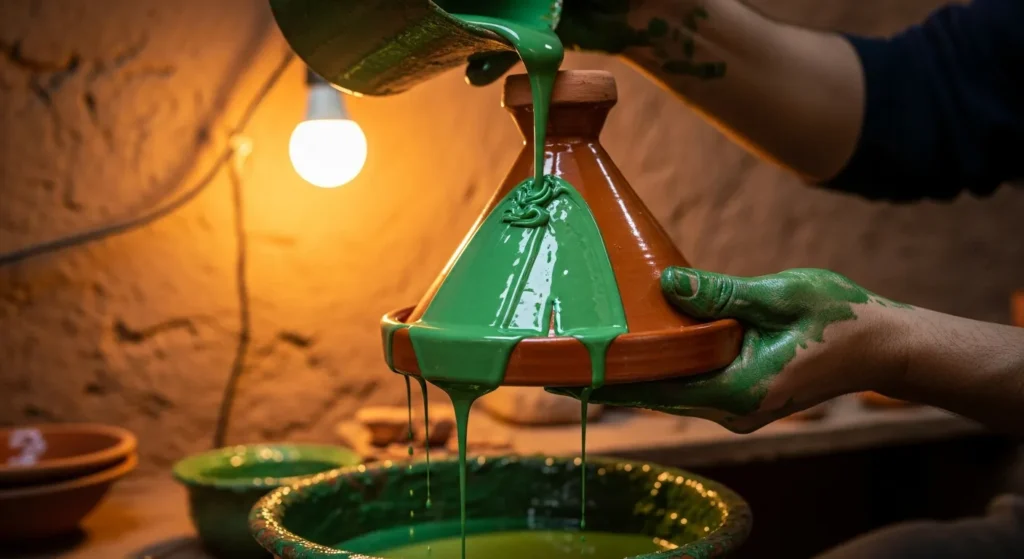
He mixes his glaze fresh each day, testing it on a shard of broken pottery before applying it to the finished pieces. The application is done by pouring — Hassan holds the tagine or bowl upside-down and pours the liquid glaze over the surface in a single, fluid motion, rotating the piece to ensure even coverage. The excess drips off and is collected for reuse. Nothing is wasted.
After glazing, the pieces dry for one day, then enter the kiln for their final firing. This firing is hotter than the first — between 900 and 1,050 degrees Celsius — and it is during this transformation that the copper oxide liquefies, flows, and solidifies into the lustrous green surface that has made Tamegroute famous.
More Than a Color
For Hassan, the green of Tamegroute is not merely an aesthetic choice. It carries meaning — layers of it, accumulated over centuries.
“Green is the color of the Prophet, peace be upon him,” Hassan explains. “In the desert, green is the color of life — of water, of palms, of everything that keeps you alive. When you put green on a tagine, you are saying: this vessel will sustain you. This food will nourish you. This meal is a blessing.”
This spiritual dimension sets Tamegroute pottery apart from the geometric precision of Fez or the painted elegance of Safi. There is something primal about it — something that connects the glossy surface of a Tamegroute tagine to the dry, sun-scorched earth it came from, as if the glaze is the clay’s dream of water.
“People come here and they want to understand the green,” Hassan says. “They ask me: what is the formula? What are the ingredients? But the real question isn’t what goes into the glaze — it’s what goes into the maker. My patience. My attention. My devotion. Forty-three years of standing in this workshop, breathing this dust, stirring this glaze. That’s what you see when you look at the green. Not copper. Not silica. Me.”
Every piece that leaves Hassan’s workshop — whether a large cooking tagine destined for a family kitchen or a small decorative piece bound for a shelf in Paris or New York — carries this intention. Hassan doesn’t see his work as manufacturing. He sees it as an offering.
Ismail: Between the Wheel and the World
Hassan’s eldest son, Ismail, is thirty-one. He is the one Hassan has chosen to carry the green forward — not because the others were unwilling, but because Ismail was the one who asked the right question.
“When Ismail was about twelve, he watched me mixing the glaze one morning,” Hassan remembers. “He didn’t ask what I was doing — all the children asked that. He asked why the green was different every time. Why it was never exactly the same shade twice. That question — the ‘why’ — told me he had the mind for it.”
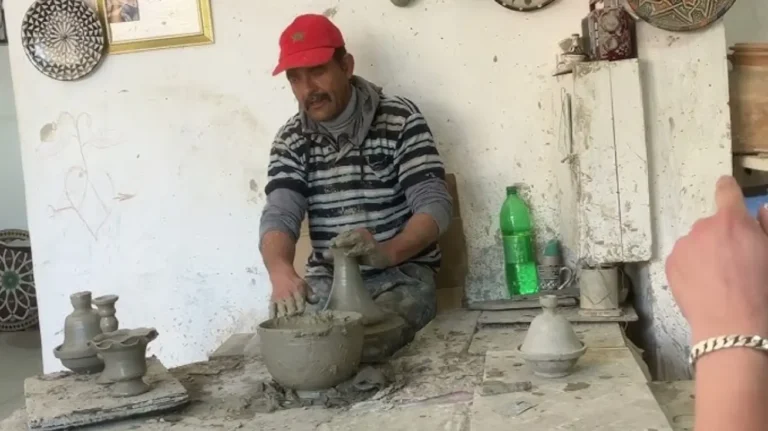
Ismail now handles most of the wheel work in the workshop. His tagines are clean, well-proportioned, and consistent. But it is the glaze that Hassan is slowly, methodically teaching him — in the same incremental, years-long apprenticeship that Moha once subjected Hassan to.
“I don’t give him the full formula yet,” Hassan says, and there is no apology in his tone. “He has the base mixture. He knows the copper and the silica. But the final adjustments — the small things that make the green sing — those I will teach him when he is ready. Not when I am ready. When he is.”
Ismail accepts this with a patience that mirrors his father’s.
“My father is right,” Ismail says simply. “The green is not information you can memorize. It is knowledge you must grow into. Like a tree. You can’t rush a tree.”
Ismail is also the bridge between the workshop and the wider world. He manages their small online presence, coordinates with buyers, and handles the logistics of shipping fragile pottery from one of the most remote villages in Morocco to kitchens across Europe and North America. He understands that the future of Tamegroute’s craft depends not only on preserving the technique but on connecting it to people who will value it.
“Every tagine we send out is an ambassador,” Ismail says. “When someone in London or Toronto cooks a fish tagine with preserved lemons in one of our pots — when they see that green glaze shining under their kitchen light — they are seeing Tamegroute. They may never come here. But Tamegroute comes to them.”
Tamegroute: The Last Stop Before the Sand
There is a well-known saying in southern Morocco: “After Tamegroute, there is only God and the desert.” The village sits at the absolute edge of habitable land — a last outpost of cultivation and community before the Sahara begins in earnest. The dunes of Erg Chebbi are visible from the highest point in the village, golden waves on the southern horizon.
This geography has shaped everything about Tamegroute — its pottery, its people, its rhythms. Water is scarce and precious. Raw materials must be sourced from the immediate surroundings. The clay comes from the banks of the Draa, Morocco’s longest river, which passes through the valley in a seasonal trickle that barely earns the name. The wood for the kiln comes from date palms and low scrub. The copper comes from small, ancient mines in the nearby Anti-Atlas mountains.
“We make everything from what is here,” Hassan says. “The earth gives us clay. The river gives us water. The mountains give us copper. The palms give us fuel. Everything comes from this place. And the tagine — the finished tagine — is a way of giving back. It takes what the land offers and transforms it into something that feeds people. It closes the circle.”
This self-sufficiency, this rootedness, is part of what makes Tamegroute pottery so resonant. In an era of global supply chains and industrial production, Hassan’s workshop operates on principles that haven’t changed in four centuries: local materials, traditional techniques, human hands, and fire.
When you hold a Tamegroute tagine — when you run your fingers over the undulating green surface, the subtle pooling and thinning of the glaze, the faintly rough texture where the copper has crystallized — you are holding the desert. You are holding the river. You are holding forty-three years of a man’s life distilled into a single, luminous object.
The Green Will Endure
At fifty-seven, Hassan shows no sign of slowing down. His back aches after long days at the wheel. His lungs bear the marks of decades of kiln smoke. His green-stained hands crack in the dry winter air. But every morning, before dawn, he is in the workshop, grinding copper, mixing glaze, preparing for another day of transformation.
“Some people ask me if I’m worried — worried that Tamegroute will be forgotten, that the young people will leave, that the green will disappear,” Hassan says. He pauses, looks at his hands, turns them over as if studying a map.
“I am not worried. The green has survived for four hundred years. It survived wars, droughts, the coming of cars and television and telephones. It survived because it is real. Because it comes from the earth, and the earth does not forget. As long as there is copper in the mountain and clay in the river and a man willing to stand in a hot workshop and stir, the green will endure.”
He picks up a small tagine — freshly glazed, still smelling faintly of the kiln — and holds it up to the doorway, where the brutal desert sun pours in. The green glaze catches the light and blazes — deep, rich, alive — against the brown and gold of the landscape behind it.
“You see?” Hassan says softly. “The desert is all one color. Everything is brown, everything is dry. But we made this. From the same earth. The same dust. We made green.”
Hassan’s Tamegroute-glazed tagines are available through our shop. Each piece is glazed and fired by hand using the centuries-old Tamegroute copper oxide technique. Browse our collection of cooking tagines, decorative tagines, and mini tagines to bring a piece of Hassan’s green into your home.
Have questions about our artisan-made tagines? Get in touch with us.
About Moroccan Tagines: We work directly with artisans across Morocco to bring you authentic, handcrafted tagines — each one made with the same care and tradition that families like Hassan’s have preserved for generations. Learn more about tagines and discover recipes that honor this timeless way of cooking.