Free Worldwide Shipping on Orders Over $150
Mohamed of Zagora: The Hands That Shape a Family’s Legacy in Clay

Before Mohamed ever touched a pottery wheel, he knew the smell of wet clay the way other children knew the smell of rain.
Growing up in Zagora — a small city at the edge of Morocco’s Draa Valley, where the Sahara begins to whisper — Mohamed’s earliest memories are woven with the rhythm of his father’s hands. Every morning, before the first call to prayer echoed across the ochre rooftops, his father Brahim would already be in the family workshop, a modest room of sun-dried brick tucked behind their home. The sound of the wheel turning was Mohamed’s lullaby, his alarm clock, and his compass all at once.
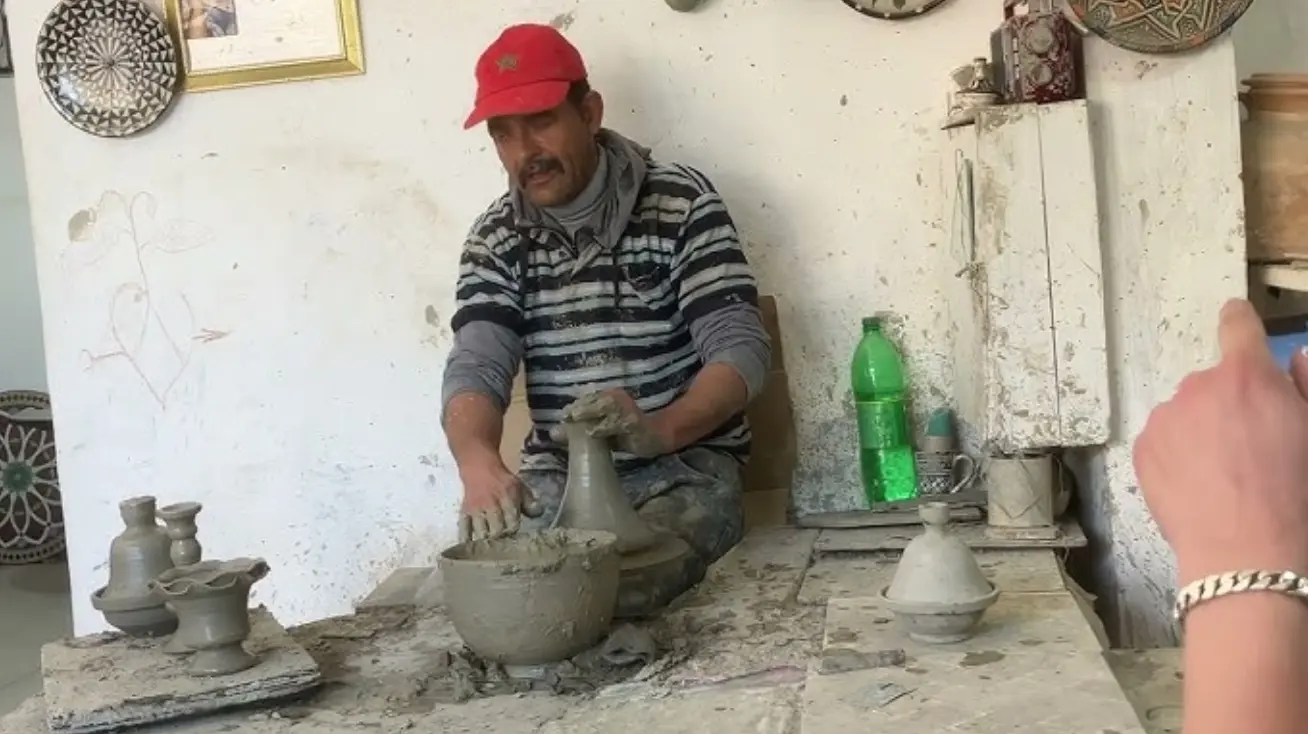
“I don’t remember a time when I didn’t know what a tagine was,” Mohamed says, a quiet smile settling beneath his mustache. “Other boys played football after school. I sat in the corner of my father’s workshop and watched him pull shapes from nothing.”
Zagora is not a place that rushes. The Draa River curves through the valley below, feeding date palms that stand like silent witnesses to centuries of trade and craft. Here, families have shaped clay into cookware for as long as anyone can remember. For the Ait Brahim family — Mohamed’s lineage — the tradition stretches back at least four generations, though Mohamed suspects it goes further. “My grandfather told my father he learned from his father,” he explains. “But before that, no one wrote it down. It was just life.”
As a child, Mohamed was not forced into the craft. His father Brahim believed that the clay had to call you — that you couldn’t simply inherit skill the way you inherit land. So Mohamed went to school, played with the neighborhood children, and lived the ordinary life of a boy growing up in southern Morocco. But every evening, he found himself back in the workshop, running his small fingers along the smooth curves of freshly turned tagines, feeling the coolness of the clay before it met the kiln’s fire.
The Day the Wheel Chose Him
Mohamed was sixteen when his father placed a lump of clay in front of him and said, simply: “Show me.”
It was 1999. Mohamed had just finished his basic schooling, and while many of his friends were thinking about moving north to Marrakech or Casablanca for work, Mohamed felt something pulling him in the opposite direction — inward, toward the workshop, toward the wheel, toward the earth beneath Zagora.
“That first tagine I made was terrible,” Mohamed laughs, shaking his head. “The walls were uneven. The lid didn’t sit right. My father looked at it for a long time, then he said, ‘Good. Now you know what not to do.’ He never told me it was bad. He just let me feel it.”
From that day forward, Mohamed became his father’s apprentice. Not in a formal, ceremonial way — there was no certificate, no graduation. It happened the way most important things in Zagora happen: quietly, naturally, like water finding its path through stone. Every morning, father and son sat side by side. Brahim shaped, Mohamed watched. Then Mohamed shaped, and Brahim watched. The corrections were gentle — a nudge of the elbow, a tilt of the head, sometimes just a sound, a soft click of the tongue that meant try again.
“My father never raised his voice in the workshop,” Mohamed remembers. “He said the clay can feel anger. If your hands are tense, the tagine will crack in the kiln. You have to be calm. You have to be present.”
Over the months and years that followed, Mohamed learned every stage of the traditional tagine-making process. He learned to source the right clay from the riverbeds near the Draa — clay that had the perfect balance ofite andite, minerals that would make the finished tagine strong enough to withstand direct flame. He learned to wedge and knead the clay until every air bubble was gone, because even one tiny pocket of trapped air could cause a tagine to explode in the kiln. He learned the precise thickness of the walls — too thin and the tagine would crack, too thick and food wouldn’t cook evenly with the gentle, spice-infused steam that makes tagine cooking so special.
And he learned the most difficult thing of all: patience.
“A tagine cannot be rushed,” Mohamed says. “The clay needs time to dry. The kiln needs time to reach temperature. The glaze needs time to set. If you rush any step, you lose everything. My father taught me that the tagine teaches you how to live — slowly, carefully, with respect for the process.”
A Father’s Passing, A Son’s Promise
Brahim worked alongside Mohamed for nearly twelve years. In that time, the small family workshop grew a quiet reputation. People from nearby villages — and eventually from cities like Ouarzazate and even Marrakech — began seeking out the Ait Brahim tagines. They were known for their even walls, their perfect lids that trapped steam in just the right way, and a certain warmth in the clay that people swore they could taste in the food.
When Brahim’s health began to decline in 2011, the transition was seamless. There was no dramatic handover, no ceremony. One morning, Mohamed simply arrived at the workshop first. He lit the kiln. He prepared the clay. And when his father shuffled in later, leaning on a cane, Brahim sat in the corner — the same corner where Mohamed had sat as a boy — and watched his son work. The wheel had turned, in every sense.
Brahim passed away in 2013, but Mohamed speaks of him as if he is still in the room.
“He is here,” Mohamed says, pressing his palm flat against a finished tagine. “Every technique I use, every curve I shape — it’s his hand guiding mine. I am just the instrument. The knowledge belongs to the family.”
The Art of Making a Tagine: Mohamed’s Process
Today, at 43, Mohamed’s hands move with the kind of confidence that only comes from repeating something ten thousand times. Watching him work is like watching a meditation.
He begins each day at dawn, before the Zagora heat becomes punishing. The clay has usually been prepared the day before — sourced, cleaned, and left to rest overnight. Mohamed wedges it by hand, folding and pressing, folding and pressing, until it reaches what he calls “the right feeling” — a consistency he can only describe through touch.
Then comes the wheel. Mohamed uses a traditional kick wheel, not an electric one. “The electric wheel is faster,” he admits. “But speed is not what I’m looking for. I need to feel the clay resisting, responding. The kick wheel lets me have a conversation with the material.”
A single cooking tagine takes Mohamed about forty minutes to shape on the wheel — the wide, shallow base first, then the iconic conical lid, formed separately and matched by eye and instinct. After shaping, the pieces dry in the shade for two to three days, depending on the season. Then comes the kiln.
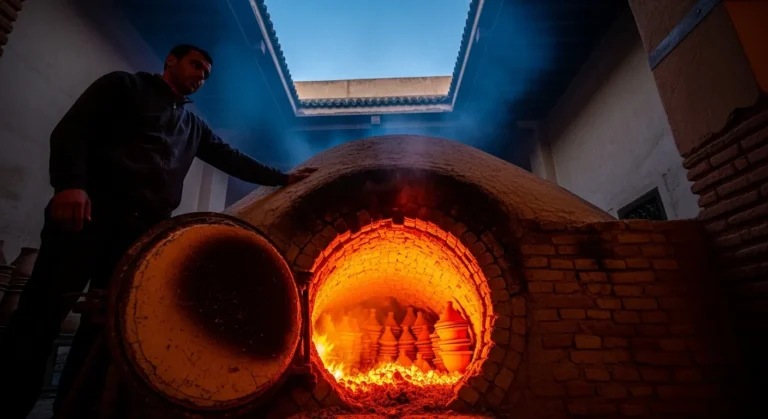
Mohamed’s kiln is wood-fired, built by his father decades ago and repaired many times since. It reaches temperatures between 800 and 1,000 degrees Celsius, and Mohamed judges the heat not with a thermometer but by the color of the flame and the sound the kiln makes.
“The kiln sings when it’s ready,” he says. “A low hum. My father taught me to listen for it.”
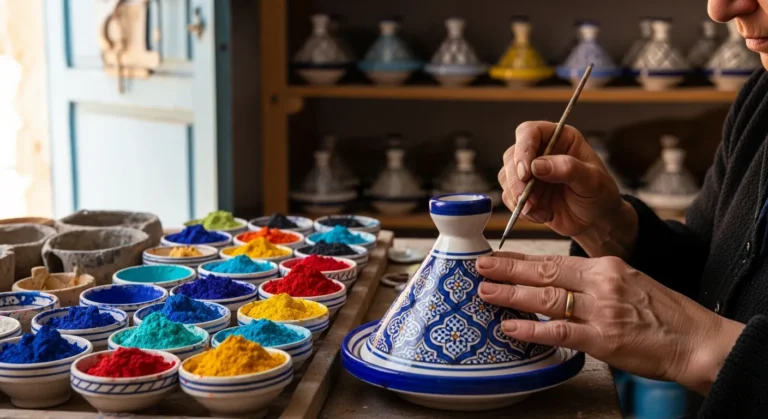
After firing, some tagines are left in their natural terracotta state — the classic rustic clay tagines that have been used in Moroccan kitchens for centuries. Others receive a glaze, hand-painted in patterns that Mohamed designs himself, drawing from the geometric traditions of Amazigh (Berber) art. The glazed tagines are fired a second time, sealing the color and creating a smooth, food-safe surface.
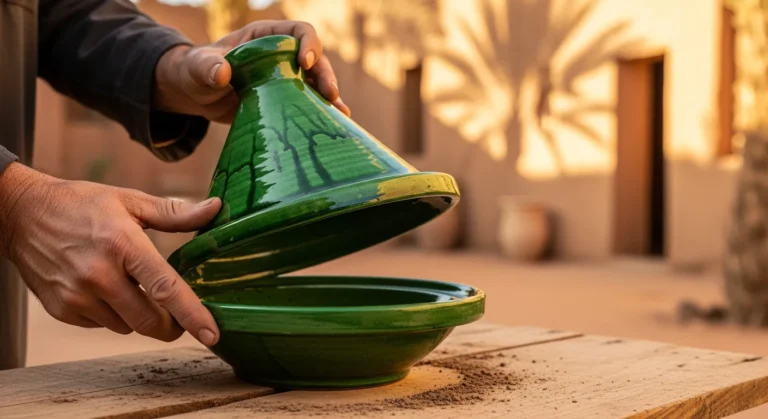
Mohamed produces between six and ten tagines a day, depending on the size and complexity. Each one is inspected with a care that borders on reverence. He taps the lid against the base, listening for the clean, bell-like ring that signals a perfect fit. He runs his fingertip along the rim, checking for any roughness. He holds each tagine up to the light, turning it slowly, searching for any imperfection invisible to a less practiced eye.
“People ask me how many tagines I have made in my life,” Mohamed says. “I don’t count them. You don’t count your children.”
Each Tagine, a Child
This is perhaps the most striking thing about Mohamed: the way he speaks about his work. There is no separation between the man and the craft. Each tagine that leaves his workshop carries, in his mind, a piece of him.
“When I shape a tagine, I give it something,” he explains, choosing his words carefully. “My energy. My attention. My time. That’s what a parent gives a child. And when the tagine goes to someone’s home, and they cook for their family, and the family sits together and eats — that’s the tagine doing its job. That’s the tagine living its life.”
This philosophy extends to his approach to imperfection. In a world of factory-made uniformity, Mohamed’s tagines bear the subtle marks of human hands — a slight variation in the curve of a lid, a faint fingerprint preserved in the glaze, a rim that is just slightly thicker on one side. To Mohamed, these are not flaws. They are character.
“A perfect tagine doesn’t exist,” he says. “And that’s what makes each one perfect. Like people. Like children. Each one is different. Each one is beautiful in its own way.”
Omar: The Next Generation
In the corner of Mohamed’s workshop, there is a small wooden stool. It is worn smooth from years of use — first by a young Mohamed, now by his son Omar.
Omar is ten years old. He has his father’s dark eyes and his grandfather’s quiet patience. After school, while other boys head to the football pitch, Omar walks through the narrow lanes of Zagora to the family workshop. He doesn’t shape tagines yet — his hands are still small, his strength still growing. But he watches. He absorbs. He asks questions that sometimes surprise his father with their depth.
“Yesterday he asked me why the tagine lid is shaped like a cone and not flat,” Mohamed recalls, his eyes bright with pride. “I told him it’s so the steam rises, cools on the inside of the lid, and falls back down onto the food — so nothing dries out, so every flavor stays inside. He thought about this for a moment and said, ‘So the tagine is like a small sky. The steam is the clouds, and the food is the earth.’ I had never thought of it that way.”
Mohamed is deliberate about how he introduces Omar to the craft. He remembers his own father’s approach — never forced, always inviting — and he follows the same path.
“I let him mix the clay sometimes,” Mohamed says. “He loves that part — getting his hands dirty, feeling the mud between his fingers. Last month, I let him paint a small decorative tagine with a brush. He painted a palm tree and a sun. It was beautiful. I kept it.”
Mohamed doesn’t pressure Omar to become a potter. He knows the world is different now than it was in 1999 when he sat at his father’s wheel for the first time. There are phones, computers, new kinds of work that didn’t exist a generation ago. But he also knows something that no technology can replicate: the feeling of creating something with your own hands, from the earth beneath your feet, that will feed families and bring people together around a table.
“If Omar chooses this path, I will teach him everything I know,” Mohamed says. “And if he doesn’t, I will still teach him to respect the clay, to respect the work, to respect where he comes from. That’s the real legacy. Not the tagines themselves — but the values that make them.”
Zagora: Where the Road Ends and the Craft Begins
There is a famous sign at the edge of Zagora that reads: “Timbuktu — 52 Days.” It marks the old caravan route across the Sahara, a reminder that this small city was once a gateway between worlds. Today, Zagora is quieter, but it remains a crossroads of a different kind — a place where ancient traditions meet the modern world, where young people weigh the pull of the cities against the gravity of home.
Mohamed has watched many of his childhood friends leave. Some went to Casablanca. Others crossed the Mediterranean to Europe. He understands their choices, respects them even. But he has never been tempted.
“Everything I need is here,” he says, gesturing around the workshop. “The clay is here. The kiln is here. My family is here. My father is here.” He pauses, taps the wall of the workshop. “In these walls. In this floor. In every tagine I make.”
Carrying the Flame Forward
At 43, Mohamed is in what he calls the “middle of the story.” His hands are strong, his eyes sharp, his instincts honed by nearly three decades at the wheel. He still makes every tagine by hand, still fires them in his father’s kiln, still listens for the song that tells him the temperature is right.
But he also looks ahead. He has begun documenting his techniques — not in writing, but through doing, through showing Omar, through welcoming the occasional visitor who wants to understand how a real Moroccan tagine is made. He has even started teaching a few young men from the neighborhood who showed interest, because he believes the craft should not be confined to one family.
“My father gave this to me,” Mohamed says. “But it doesn’t belong to me. It belongs to Zagora. It belongs to Morocco. It belongs to anyone who sits down to a meal cooked in a tagine and tastes something they can’t quite name — something old, something warm, something real.”
When you hold one of Mohamed’s tagines in your hands, you feel the weight of it — not just the physical weight of the clay, but the weight of everything it carries. Twenty-seven years of skill. Four generations of knowledge. The heat of a Zagora summer. The coolness of river clay. The patience of a father teaching a son. The hope of a son watching his own child begin to understand.
And somewhere in Zagora, as the sun sets behind the Atlas foothills and the call to prayer drifts over the palm groves, Mohamed is already preparing clay for tomorrow. The wheel will turn again. The kiln will sing. And another tagine — another child — will come into the world.
Mohamed’s handcrafted tagines are available through our shop. Each piece is made by hand in Zagora using techniques passed down through generations. Browse our collection of cooking tagines, decorative tagines, and mini tagines to bring a piece of Mohamed’s craft into your home.
Have questions about our artisan-made tagines? Get in touch with us.
About Moroccan Tagines: We work directly with artisans across Morocco to bring you authentic, handcrafted tagines — each one made with the same care and tradition that families like Mohamed’s have preserved for generations. Learn more about tagines and discover recipes that honor this timeless way of cooking.