Free Worldwide Shipping on Orders Over $150
Fatima of Safi: The Woman Who Paints Stories Into Clay

In the coastal city of Safi, where the Atlantic wind carries the scent of salt and kiln smoke through narrow blue-and-white streets, Fatima Benchekroun sits at a low wooden table and does what she has done every day for thirty-one years: she paints.
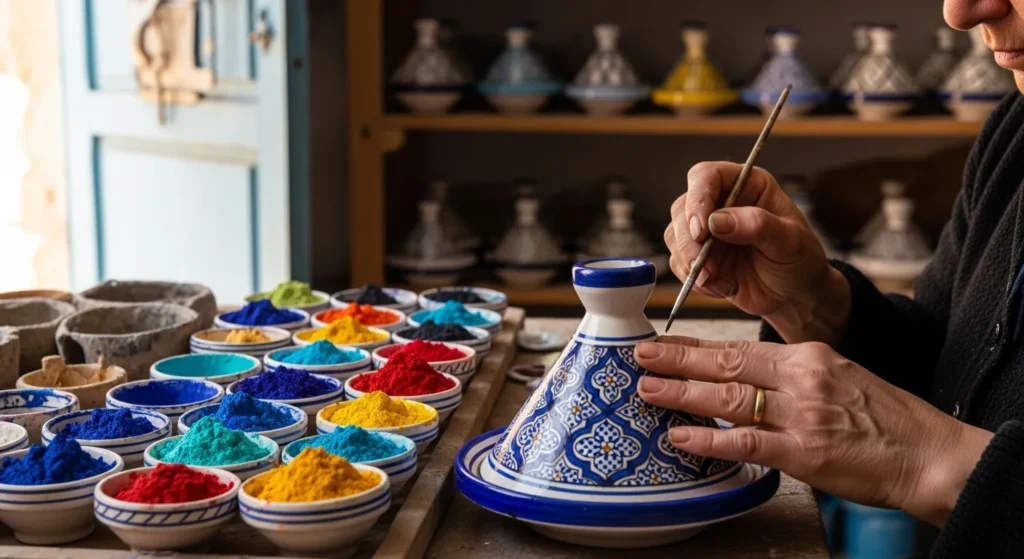
Not canvases. Not walls. She paints tagines.
Each stroke of her horsehair brush is unhurried. Each line follows a geometry that exists somewhere between mathematics and memory — patterns her mother taught her, patterns her grandmother taught her mother, patterns that have adorned the pottery of Safi for as long as anyone can remember. Fatima is sixty-three years old, and her hands have never trembled. Not once.
“The brush knows where to go,” she says, not looking up from her work. “I just follow.”
A Girl Among the Potters
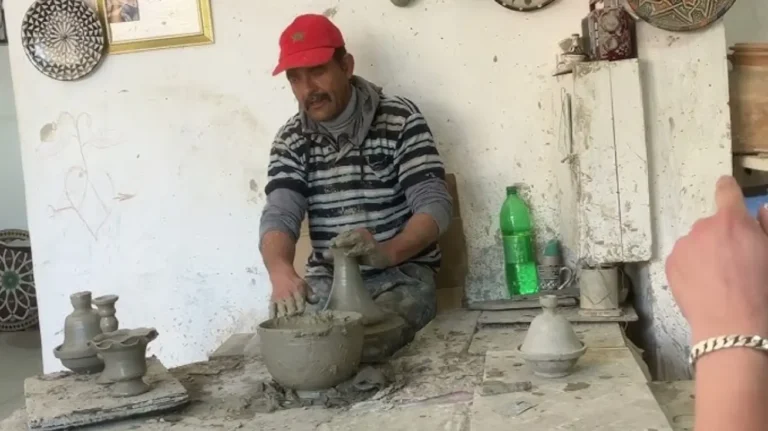
Safi has been Morocco’s pottery capital for centuries. The city’s hillside quarter, known locally as Colline des Potiers — the Potters’ Hill — is a labyrinth of workshops, kilns, and drying terraces where the craft is less an industry than a way of life. Growing up here in the 1960s, Fatima was surrounded by clay the way children in fishing villages are surrounded by the sea. It was everywhere. Inescapable. Ordinary.
But in those days, pottery was men’s work. The men dug the clay, threw the wheel, loaded the kilns. Women’s contributions were acknowledged but rarely celebrated. They prepared glazes. They cleaned. And some of them — the ones with steady hands and sharp eyes — painted.
Fatima’s mother, Khadija, was one of the best painters on the hill. She worked in a neighbor’s workshop, arriving before dawn and painting until the light grew too dim to distinguish cobalt from black. She was paid by the piece — a few dirhams for each tagine, each plate, each bowl she decorated with the swirling arabesques and eight-pointed stars that define Safi ceramics.
“I used to sit under her table,” Fatima remembers. “I could see her feet — she wore yellow babouches, always yellow — and I could hear the brush on the clay. It made a sound like whispering. I thought she was telling secrets to the tagines.”
When Fatima was nine, Khadija placed a ruined tagine in front of her — one with a hairline crack that couldn’t be sold — and handed her a brush dipped in blue.
“She said, ‘Paint whatever you see when you close your eyes,'” Fatima recalls. “I painted a fish. It was terrible. But my mother looked at it and said, ‘The fish is swimming. That means you have the gift.'”
The Apprenticeship of a Lifetime
From that day, Fatima painted. Not occasionally, not as a hobby — every day, for hours, with a discipline that surprised even Khadija. By the time she was fourteen, Fatima could execute the traditional Safi motifs freehand, without guides or stencils: the nejma (star), the khamsa (hand), the interlocking diamonds that represent family unity, the flowing vine patterns that symbolize abundance.
But Fatima didn’t just replicate. She innovated — carefully, respectfully, within the grammar of tradition. She began incorporating motifs from the natural world around her: stylized waves inspired by the Atlantic, clusters of argan leaves, the silhouette of Safi’s Portuguese fortress against the evening sky. Her patterns were recognizably Safi, but unmistakably hers.
“Tradition is not a cage,” Fatima says. “It is a language. Once you learn its grammar, you can say new things. But you must learn the grammar first. That takes years.”
By her early twenties, Fatima had become one of the most sought-after painters on the Potters’ Hill. Workshop owners competed for her services. But Fatima wanted something different. She wanted her own table, her own brushes, her own rhythm.
In 1993, with savings accumulated over a decade of painting, Fatima set up a small painting station in her family home — just a table, a stool, a window for light, and her mother’s old brush set. She began taking commissions directly from workshops and, eventually, from the merchants who supplied Morocco’s souks and international buyers.
How Fatima Paints a Tagine
Watching Fatima work is like watching a calligrapher compose a poem. There is no hesitation, no erasure, no second-guessing. The brush moves in arcs and angles that seem guided by something beyond conscious thought.
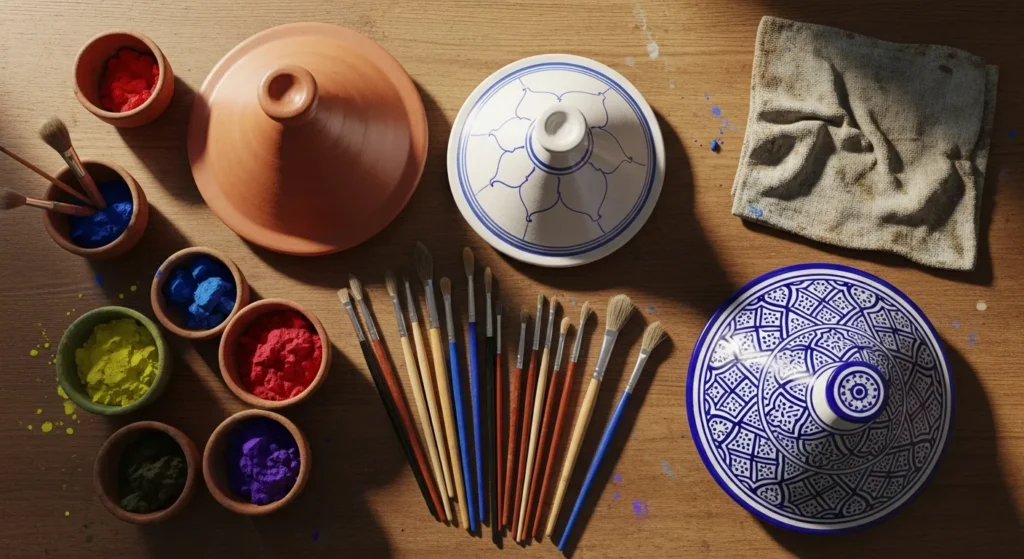
Her process begins with the bare, fired tagine — a cooking tagine that has already been shaped on the wheel and fired once in the kiln. She inspects each piece by touch, running her fingertips across the surface to check for bumps, pits, or irregularities that would disrupt the paint.
“A rough surface eats the brush,” she explains. “The paint bleeds. The line loses its confidence.”
Satisfied with the surface, Fatima mixes her glazes — mineral-based pigments that she blends herself using recipes passed down through her family. Cobalt oxide for the deep blue that Safi is famous for. Antimony for yellow. Manganese for brown-black. Copper oxide for the green that appears in her more elaborate pieces. Every pigment is mixed with a liquid glaze base and ground to a consistency that Fatima describes as “like cream — not milk, not yogurt. Cream.”
Then she paints. A decorative tagine takes Fatima between two and four hours, depending on the complexity of the design. She works without pencil guidelines, building the pattern from the center outward in concentric rings of increasing complexity. The geometric precision of her work — lines that are perfectly parallel, curves that are perfectly symmetrical — is achieved entirely by hand and eye.
“People see the pattern and they think I plan every line in advance,” Fatima says. “I don’t. I plan the feeling. I know how I want the tagine to feel when someone looks at it — calm or joyful or strong — and the pattern follows the feeling.”
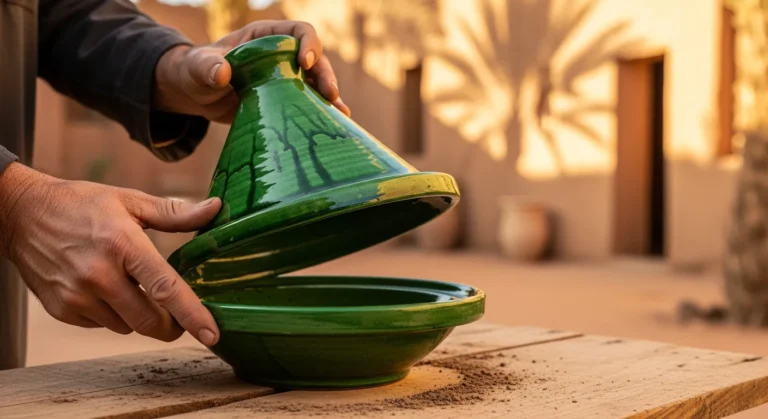
After painting, the tagine returns to the kiln for a second firing, which vitrifies the glaze and locks the colors permanently into the surface. When it emerges, the pigments have transformed: the dull, chalky pre-fire blues have become vivid and luminous, the yellows have deepened to saffron, and the entire surface gleams with a glassy sheen that will last for generations.
The Language in the Lines
What sets Fatima’s work apart is not just her technical skill — it is her conviction that every pattern carries meaning. In a culture where geometric art has served for centuries as a visual language, Fatima is a fluent speaker.
“Every motif tells you something,” she explains, pointing to a freshly painted tagine. “The eight-pointed star represents balance — the four cardinal directions and the four elements meeting at a center point. When I place it on a tagine, I am saying: may the food you cook in this pot bring balance to your table, to your family.”
She picks up another tagine, this one decorated with interlocking diamonds.
“This pattern is called tashkilt — union. Each diamond is a family member. They overlap because in Moroccan life, families are not separate. They are woven together. When you serve a meal in this tagine, the pattern reminds you that eating together is itself an act of union.”
This depth of intention is what transforms a painted tagine from a decorated object into something closer to an amulet — a vessel that carries both food and meaning.
“A factory can copy my lines,” Fatima says firmly. “But it cannot copy my intention. That’s the difference between a machine and a maker.”
Nadia: The Daughter Who Chose the Brush
Like Mohamed in Zagora, Fatima faces the question every traditional artisan confronts: who will carry this forward?
Her answer arrived unexpectedly. Three of Fatima’s four children pursued modern careers — a pharmacist, an accountant, a teacher. But her youngest daughter, Nadia, now twenty-six, chose the brush.
“I didn’t encourage her and I didn’t discourage her,” Fatima says. “I remembered what my mother did for me — she just put the brush in my hand and stepped back. I did the same for Nadia.”
Nadia’s style is different from her mother’s — bolder, more experimental, with influences from contemporary graphic design that she discovers on her phone. She has introduced new color combinations: turquoise with copper, white with deep olive green. Some of the traditional painters on the Potters’ Hill raise their eyebrows. Fatima just smiles.
“She is speaking the same language in a new accent,” Fatima says. “That is how a tradition stays alive. Not by repeating it exactly — but by loving it enough to make it your own.”
Mother and daughter now work side by side at the same table where Fatima began thirty-one years ago — Khadija’s table, inherited and repaired so many times that only the legs are original. Sometimes Fatima will glance at Nadia’s work and nod. Sometimes she will tilt her head — the same gesture Khadijah once used — which Nadia understands means consider that line again. No words needed.
Safi: The City That Breathes Clay
Safi is not a city that appears in most tourist guidebooks. It lacks the spectacle of Marrakech, the blue-painted charm of Chefchaouen, the imperial weight of Fez. But what Safi has — what it has always had — is clay.
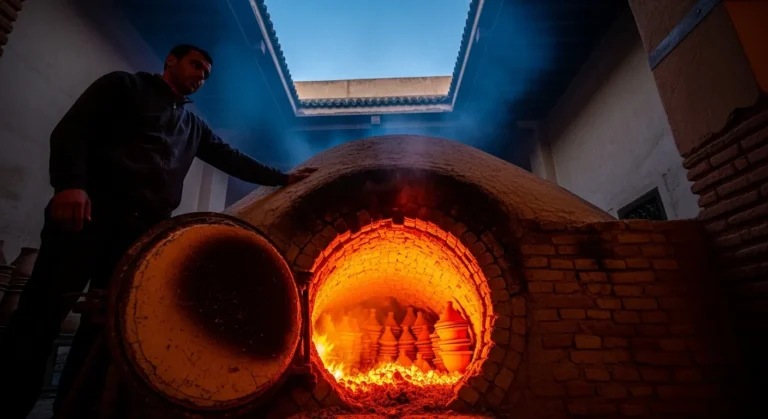
The clay that Safi potters use comes from deposits just outside the city, earth that has been quarried for centuries. It is a particular clay — rich in iron oxide, which gives Safi terracotta its distinctive warm reddish tone and makes the fired pottery exceptionally strong. The kilns on the Potters’ Hill are communal, shared among workshops in a system of cooperation that has survived modernization.
“In Safi, the potters are a family,” Fatima says. “We compete, yes — but we also share the kiln. We share knowledge. If a young potter doesn’t know how to mix a glaze, he asks. No one refuses to teach. Because if one workshop fails, the whole hill suffers.”
This communal spirit is part of why Moroccan pottery retains its vitality. It is not a museum piece preserved behind glass. It is a living practice, sustained by real relationships between real people who depend on each other.
When you hold a tagine painted by Fatima — when you run your thumb across the glossy surface and feel the impossibly fine lines beneath your skin — you are holding a piece of Safi. The salt air. The Atlantic light. The echo of Khadija’s whispering brush. The steady, patient hands of a woman who has never once trembled.
Carrying the Colors Forward
At sixty-three, Fatima shows no sign of slowing down. Her eyesight remains sharp. Her hands remain steady. Her brushes — some of them the same horsehair brushes her mother used — have been rebound and resharpened so many times they are more memory than tool.
“I will paint until the day my hands say no,” Fatima says simply. “And even then, I will mix the glazes for Nadia. I will tell her which blue is right for which feeling. You can lose your hands. You cannot lose what you know.”
She picks up a freshly fired tagine — one of her own, a classic Safi design in cobalt and white — and turns it slowly in the light from the window. For a moment, the geometric pattern catches the sun and seems to glow from within, as if the kiln’s fire is still alive inside the clay.
“This one is going to someone’s kitchen,” she says. “Someone I will never meet, in a country I may never visit. But when they lift the lid and the steam rises and they smell the spices and they serve the food — at that moment, I am there. My brushstrokes are there. My mother’s teaching is there. Safi is there.”
She sets the tagine down, gently.
“That is why I paint. Not for the money. Not for recognition. I paint because it is how I travel. It is how I reach people I will never know. It is how I say: I was here, I made this, it matters.”
Fatima’s hand-painted tagines are available through our shop. Each piece is painted by hand in Safi using mineral pigments and techniques passed down through generations. Browse our collection of cooking tagines, decorative tagines, and mini tagines to bring a piece of Fatima’s art into your home.
Have questions about our artisan-made tagines? Get in touch with us.
About Moroccan Tagines: We work directly with artisans across Morocco to bring you authentic, handcrafted tagines — each one made with the same care and tradition that families like Fatima’s have preserved for generations. Learn more about tagines and discover recipes that honor this timeless way of cooking.