Free Worldwide Shipping on Orders Over $150
Youssef of Fez: Where Fire and Faith Meet in the World’s Oldest Kilns

The kiln has been burning since three o’clock in the morning. It is now past seven, and the temperature inside the ancient brick chamber has climbed past 900 degrees Celsius. The air around it shimmers. The walls glow a deep, living orange. And Youssef Amrani stands three feet from the mouth of the kiln, barefoot on the stone floor, reading the fire the way a sailor reads the sea.
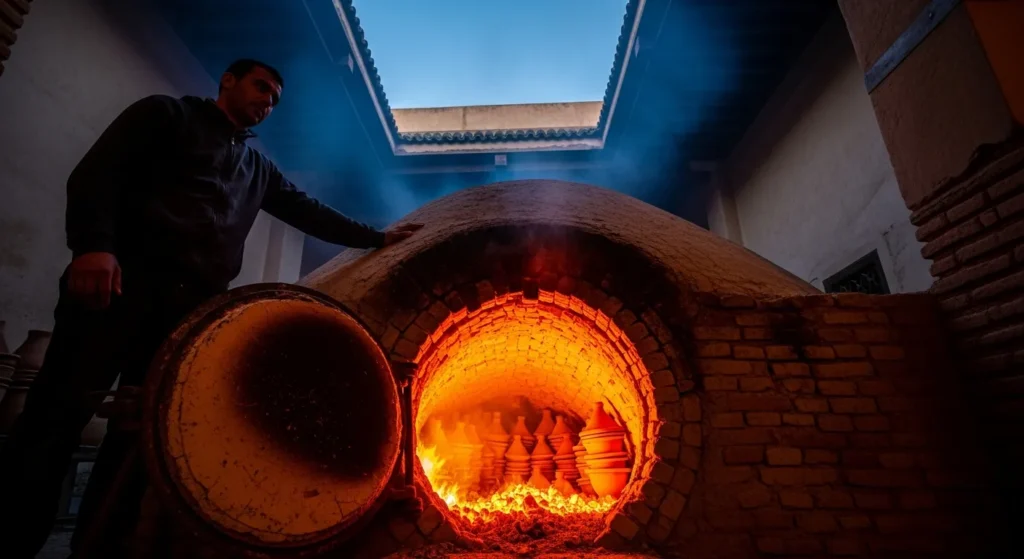
“You watch the color,” he says, not taking his eyes from the kiln. “Not the color of the flame — the color of the air above the pots. When it turns from orange to almost white, like the belly of a cloud at sunrise, the kiln is ready.”
Youssef is fifty-one years old. He is a master kiln operator — mouallem al-faran — in the Ain Nokbi pottery quarter of Fez, Morocco’s ancient spiritual capital i know as FEZ. He has been firing clay since he was twelve. He has burned his hands more times than he can count. He has lost eyebrows, singed his beard, and once — in a story he tells with a quiet, almost reverential seriousness — saved an entire kiln load of tagines by staying awake for thirty-six consecutive hours when the fire threatened to die during a winter rainstorm.
“The kiln does not care about your schedule,” Youssef says. “It does not care that you are tired or hungry or cold. It has its own time. Your job is to serve it.”
The Boy Who Fed the Fire
Youssef’s family has no history in pottery. His father was a leather worker in the famous tanneries of Fez — the chouara — and expected his son to follow the same path. But at twelve, Youssef wandered into the wrong courtyard.
“I was running an errand for my father,” he remembers, sitting on an overturned bucket outside his kiln, his hands wrapped around a glass of mint tea. “I took a shortcut through Ain Nokbi, and I heard this sound — a roar, like a sleeping animal breathing. I followed it. And I found the kiln.”
The kiln master at the time was an elderly man named Haj Driss, who had been firing pots in that same kiln for over fifty years. He saw the boy standing in the doorway, mouth open, eyes reflecting the fire, and did what Moroccan craftsmen have always done with curious children: he put him to work.
“He handed me an armful of olive wood and said, ‘Feed it,'” Youssef recalls. “I didn’t know what he meant. He pointed at the kiln mouth. I threw the wood in. The fire roared. I felt the heat on my face, and something shifted inside me. I can’t explain it. It was like the fire recognized me.”
From that day, Youssef returned to Haj Driss’s kiln every afternoon after school. His father disapproved. His mother worried. But something in the boy’s determination — the way he came home each evening smelling of smoke and clay with singed eyebrows and a look of absolute contentment — eventually softened his parents’ resistance.
“My father said, ‘If you must do this, then be the best,'” Youssef remembers. “He didn’t understand it. But he respected commitment. That was enough.”
The Invisible Craft
Youssef’s role in the pottery chain is one most people never see or consider. The wheelworkers shape the clay. The painters decorate the surfaces. The merchants sell the finished pieces. But between shaping and selling, there is the kiln — and without the kiln master, every piece is just mud.
“People think firing is simple,” Youssef says, and for the first time, there is an edge in his voice. “Put pots in. Make them hot. Take them out. That’s like saying surgery is simple — just cut and stitch. The kiln is alive. It breathes. It has moods. Some days the draft pulls perfectly and the temperature rises clean and smooth. Other days, the wind changes, the wood is too wet, the chimney doesn’t draw, and you are fighting the fire for twelve hours.”
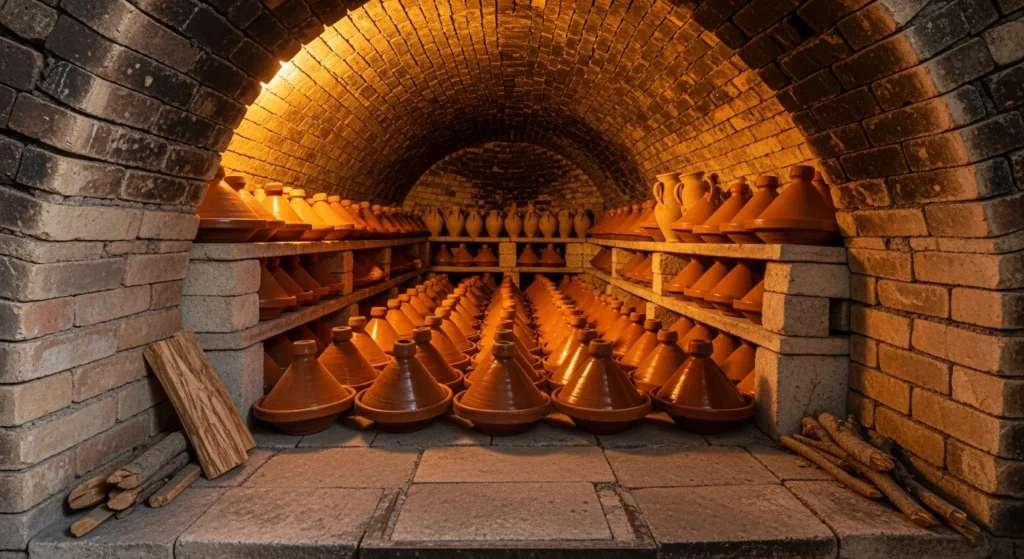
A typical firing cycle in Youssef’s kiln lasts between fourteen and eighteen hours. He begins loading at midnight — stacking cooking tagines, plates, bowls, and decorative pieces on shelves inside the cylindrical chamber with a precision born from decades of practice. Each piece must be positioned to receive heat evenly. Larger pieces go near the bottom where heat is most intense. Smaller, more delicate items — like mini tagines and intricately painted decorative tagines — are placed higher, where the temperature is slightly more moderate.
“Loading the kiln is like building a house,” Youssef says. “The structure must be right. If one piece is in the wrong place, it blocks the heat from reaching the piece behind it. Then that piece is underfired. It will be weak. It might crack in someone’s kitchen. My job is to make sure that never happens.”
After loading, Youssef seals the kiln entrance with a wall of wet clay bricks, leaving only the fire door open. Then he lights the fire.
Reading the Fire
The first four hours are the most critical — and the most dangerous. Youssef feeds the kiln with olive wood and palm fronds, building the temperature slowly, degree by degree. Too fast, and the thermal shock will crack the unfired clay. Too slow, and the kiln won’t reach the temperatures needed to vitrify the clay’s minerals into a hard, waterproof surface.
“The first hours are like warming up a child with a fever,” Youssef says. “Gently. Patiently. You don’t throw a blanket on them — you wrap them slowly. The clay is the same. It needs to feel the heat coming gradually, like dawn.”
Youssef monitors the kiln through a series of small peepholes drilled into the brick walls at different heights. He peers through each one in rotation, checking the color of the interior, the behavior of the flames, the state of the pots visible through the haze of heat. He has no digital thermometer. No pyrometric cones. Only his eyes, blackened and lined from decades of squinting into fire.
By hour eight, the kiln has reached approximately 600 degrees Celsius. The tagines inside have changed color — from the dusty grey of raw clay to a dull, blood-dark red. By hour twelve, the temperature pushes past 800 degrees. The air inside is so hot it becomes almost transparent, and the pots begin to glow with their own light.
“There is a moment,” Youssef says, his voice dropping to something close to awe, “when the tagines become the same color as the fire. They disappear into it. You can’t tell where the pot ends and the flame begins. That is the moment of transformation. That is when mud becomes a tagine.”
By hour fourteen or fifteen, Youssef judges the firing complete. He seals the fire door, blocks the chimney damper, and lets the kiln cool — a process that takes another twenty-four to thirty-six hours. Opening the kiln too early would flood the superheated interior with cool air, cracking everything inside.
“Patience again,” Youssef says, this time with a tired smile. “Always patience. The kiln teaches the same lesson as the clay, as the wheel, as the brush. Everything in pottery comes back to patience.”
A Conversation with the Ancestors
Youssef’s kiln is not his. It belongs, in a sense, to centuries.
The kiln in Ain Nokbi is estimated to be over 400 years old — one of the oldest continuously operated pottery kilns in Morocco, possibly in the world. Its brick walls are layered with the residue of countless firings: ash, glaze drippings, soot, mineral deposits that have formed geological strata of their own. When Youssef presses his hand against the kiln’s inner wall, he is touching surfaces that were built when Fez was the intellectual capital of the Islamic world.
“I am not the owner of this kiln,” Youssef says. “I am its caretaker. Before me was Haj Driss. Before him was his uncle. Before his uncle, men whose names we’ve forgotten. But the kiln remembers. The walls remember. Every firing leaves a mark, and every mark is a conversation with the men who came before.”
This sense of continuity is central to Youssef’s identity. He doesn’t see himself as an individual craftsman; he sees himself as a link in a chain. The pots he fires today will be used in kitchens tomorrow — someone will cook a chicken tagine with apricots and almonds or a beef tagine with prunes in a pot that passed through his fire — and that chain connects the meal on a stranger’s table to a 400-year-old kiln in a narrow alley in Fez.
“That is sacred,” Youssef says. “Not in a religious way — in a human way. Connection across time. That’s what the kiln gives us.”
The Question of Tomorrow
Unlike Mohamed in Zagora, whose son Omar watches from a corner stool, Youssef has no immediate successor. His two sons have both moved to Casablanca — one works in logistics, the other studies engineering. They visit during Ramadan and holidays, but neither has expressed interest in the kiln.
Youssef doesn’t blame them. He understands.
“It is hard work,” he says plainly. “The heat. The hours. The smoke in your lungs. I cannot promise my sons the life I had — the satisfaction, yes, but also the struggle. They must make their own choices.”
But the craft will not die. Youssef has trained three young men from the Ain Nokbi quarter over the past decade. One of them, Rachid, aged twenty-eight, now handles roughly half the firings. Youssef watches Rachid the way Haj Driss once watched him — with a mixture of pride and vigilance, correcting through small gestures rather than words.
“Rachid is good,” Youssef says. “He has the ear for it. He can hear when the draft changes, when the wood is burning unevenly, when a pot has shifted inside the kiln. That’s not something you can teach. You can only teach someone who already has it to listen more carefully.”
Fez: The City That Holds Time
Fez is a city of layers. The medieval medina — the oldest in the world, a UNESCO World Heritage site — is a maze of 9,000 alleys where donkeys carry goods that delivery trucks cannot reach. Tanneries still use the same vats that have been in operation for a thousand years. Call-to-prayer echoes overlap from hundreds of mosques, creating a soundscape that hasn’t fundamentally changed in centuries.
For Youssef, Fez is not a museum. It is a living, working city where tradition operates alongside modernity not as a tourist attraction but as an economic and spiritual reality.
“People come to Fez and they say, ‘How charming, how old,'” Youssef observes. “But they don’t understand. We don’t live this way because it’s charming. We live this way because it works. The kiln works. The clay works. The methods work. Why would we change what works just to appear modern?”
When you cook with a tagine that was fired in Youssef’s kiln — when you season it with olive oil and patience, when you set it over low heat and let the centuries-old design do its quiet work — you are tasting something that Youssef’s fire helped create. The kiln gave it strength. The flame gave it permanence. And a barefoot man in a narrow alley in Fez gave it his attention, his skill, and his time.
The Fire Never Goes Out
It is past noon now. The kiln has been sealed, the fire door bricked shut. Youssef will not open it until tomorrow evening. For now, the heat slowly dissipates through 400-year-old walls, and somewhere inside, a hundred tagines are cooling into their final forms — hard, resonant, ready for a lifetime of cooking.
Youssef stretches his back, drinks the last of his tea, and looks at the kiln with an expression that is difficult to describe. It is not affection, exactly. It is not reverence. It is the look of a man who has spent nearly four decades in a conversation with something older and bigger than himself, and who knows that the conversation is not finished.
“The fire in this kiln has been burning for four hundred years,” Youssef says. “Sometimes it sleeps. But it never goes out. And as long as someone is here to feed it, to listen to it, to understand it — it never will.”
Youssef’s kiln-fired tagines are available through our shop. Each piece is fired by hand in Fez using techniques preserved for centuries. Browse our collection of cooking tagines, decorative tagines, and mini tagines to bring a piece of Youssef’s fire into your home.
Have questions about our artisan-made tagines? Get in touch with us.
About Moroccan Tagines: We work directly with artisans across Morocco to bring you authentic, handcrafted tagines — each one made with the same care and tradition that craftsmen like Youssef have preserved for generations. Learn more about tagines and discover recipes that honor this timeless way of cooking.