Free Worldwide Shipping on Orders Over $150
Tagine vs Dutch Oven vs Slow Cooker: Which Slow-Cook Vessel Is Right for You?

If you’ve ever searched for the best way to slow-cook a rich, tender stew at home, chances are you’ve compared a tagine vs Dutch oven at some point. Throw the electric slow cooker into the mix, and the decision gets even trickier. All three promise tender meat, deep flavors, and comforting one-pot meals—but they achieve those results through fundamentally different methods.
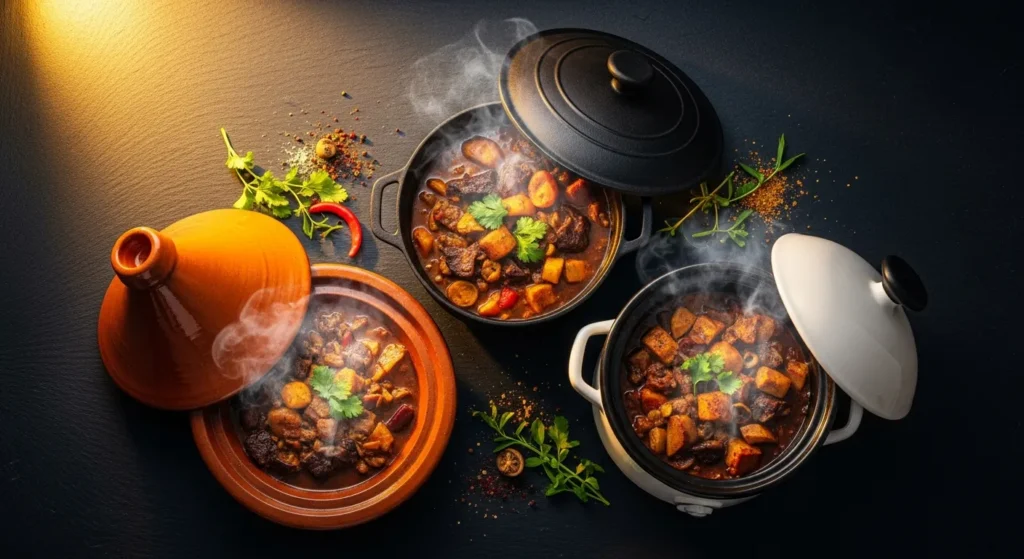
The truth is, each vessel has strengths the others can’t replicate. A tagine concentrates flavor through an ingenious self-basting cycle perfected over centuries. A Dutch oven delivers brute-force versatility across every heat source in your kitchen. A slow cooker trades hands-on technique for pure convenience.
So which one deserves space on your shelf? This guide breaks down everything—cooking method, flavor results, versatility, cost, and practical use—so you can choose the best slow cooking vessel for the way you actually cook.
How Each Vessel Works: The Science of Slow Cooking
Before we compare results, it helps to understand what’s happening inside each pot. The mechanics of heat and moisture are where these three vessels diverge most sharply.
The Tagine: Self-Basting Through Condensation
The tagine cooking vessel is a two-part design: a wide, shallow clay base and a tall conical lid. This shape isn’t decorative—it’s engineered.
As food simmers on low heat, steam rises into the cool upper reaches of the cone. The moisture condenses on the inner surface of the lid and drips back down onto the food in a continuous, self-basting cycle. The result is a dish that cooks in its own concentrated juices, requiring remarkably little added liquid.
This is why tagine dishes are known for their intensely concentrated flavors—the food isn’t diluted by excess broth. It’s essentially braised in its own aromatic essence.
The Dutch Oven: Even Heat From Heavy Walls
A Dutch oven is a thick-walled, heavy-lidded pot—typically cast iron or enameled cast iron. It works through brute thermal mass: the heavy walls absorb and radiate heat evenly from all directions, while the tight-fitting flat lid traps steam inside.
Unlike a tagine, the Dutch oven doesn’t create a condensation cycle. Instead, it relies on generous amounts of liquid (broth, wine, water) to braise and stew. The heavy lid prevents most evaporation, but the cooking principle is different. You’re simmering food in liquid rather than above it.
The Slow Cooker: Low Heat, No Supervision
An electric slow cooker (like a Crock-Pot) uses a heating element wrapped around a ceramic insert to maintain a steady low temperature over many hours. The sealed glass or plastic lid traps moisture.
The slow cooker’s advantage is pure automation: set it in the morning, return to a cooked meal in the evening. However, the constant low heat and lack of browning means flavors develop differently—often flatter and less concentrated than either the tagine or Dutch oven.

Tagine vs Dutch Oven: A Head-to-Head Comparison
This is the matchup most home cooks want settled. Both are serious slow-cooking tools, but they produce noticeably different results.
Flavor and Texture
The tagine wins on flavor concentration. Because the conical lid continuously recycles moisture back into the dish, tagine meals taste more intense and aromatic. The flavors of cumin, saffron, preserved lemons, and slow-braised meat meld into something deeply layered—and you’ll taste the difference after the first bite.
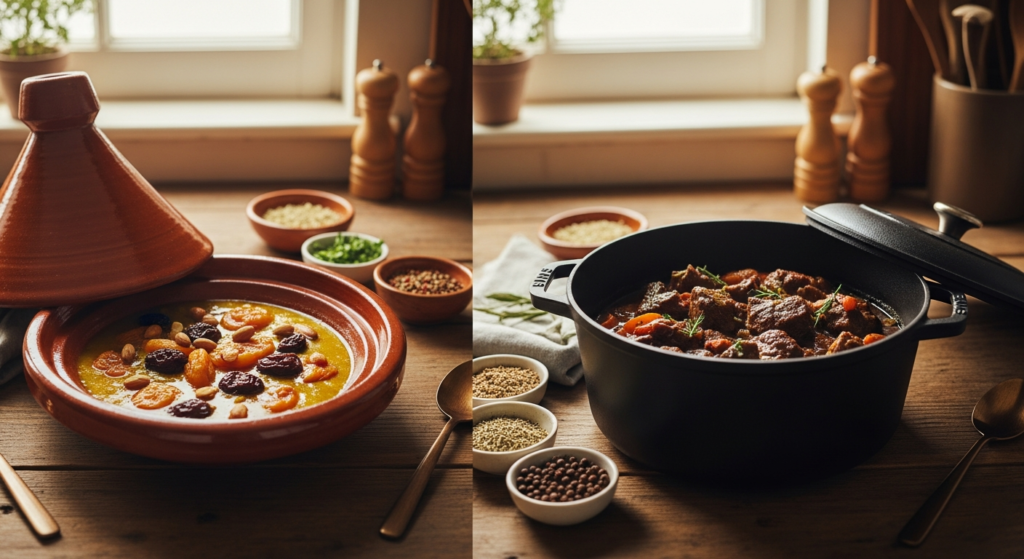
A Dutch oven produces excellent braises and stews, but the flavors tend to be more evenly distributed throughout a larger volume of liquid. The result is rich and satisfying, but less concentrated than what a tagine delivers.
For texture, both excel at transforming tough cuts into tender, fall-apart meat. The tagine achieves this with less liquid, so the sauce is thicker and more reduced. Dutch oven braises are saucier and more broth-forward.
Versatility
This round goes to the Dutch oven—and it’s not close. A Dutch oven can:
- Sear and brown meat at high heat before braising
- Bake bread, roast chicken, or deep-fry
- Work on any heat source: gas, electric, ceramic, induction
- Go from stovetop to oven seamlessly
- Handle acidic ingredients without issue
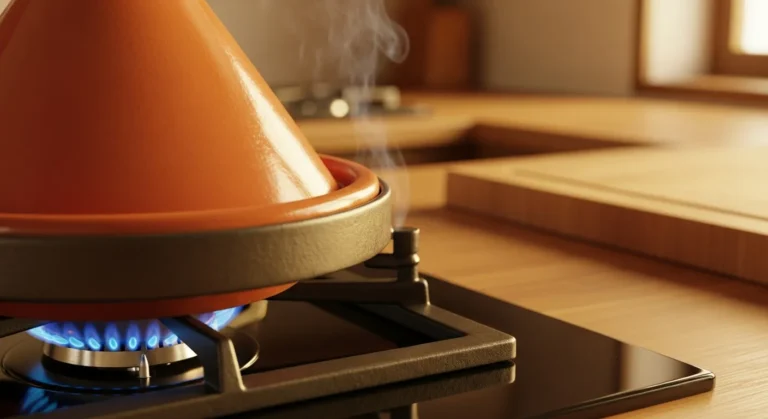
A tagine, by contrast, is purpose-built. It excels at one thing—slow, low, moist cooking—and does it better than almost anything else. But you can’t sear in a clay tagine, you can’t use it on induction (without a compatible diffuser), and you need a heat diffuser on most stovetops to protect the clay.
Heat Source Compatibility
| Heat Source | Tagine | Dutch Oven |
|---|---|---|
| Gas stovetop | ✔ (with diffuser) | ✔ |
| Electric coil | ✔ (with diffuser) | ✔ |
| Ceramic/glass top | ✔ (diffuser recommended) | ✔ |
| Induction | ✘ (unless cast iron) | ✔ |
| Oven | ✔ (start cold) | ✔ |
| Charcoal/open fire | ✔ | ✔ |
Durability and Maintenance
Dutch ovens—especially enameled cast iron—are virtually indestructible. They resist thermal shock, tolerate aggressive scrubbing, and can last a lifetime with minimal care.
Clay tagines require more attention. They must be seasoned before first use, heated gradually to avoid thermal shock, hand-washed without soap (for unglazed models), and stored with care. But with proper tagine care, a handcrafted clay tagine can last decades—many Moroccan families cook with tagines passed down through generations.
The Cultural Experience
This is where the tagine stands alone. Cooking with a handmade Moroccan tagine isn’t just about the food—it’s about connecting with a centuries-old tradition. The ritual of slow-heating the clay, layering spices and ingredients, and lifting that conical lid to release an intoxicating cloud of steam is an experience a Dutch oven simply can’t replicate.
When you cook with an authentic clay tagine, you’re participating in a culinary tradition that stretches back to the Berber communities of North Africa—a philosophy that values patience, simplicity, and the belief that time itself is an ingredient.
Tagine vs Slow Cooker: Convenience vs Craft
The tagine vs slow cooker comparison comes down to what you value more: depth of flavor or hands-off convenience.
Where the Slow Cooker Wins
- Set-and-forget cooking: Load it, set the timer, walk away for 6–8 hours
- No heat management: The appliance controls the temperature automatically
- No special prep: No seasoning, no diffusers, no gradual heating
- Safe unattended use: Designed to run while you’re away from home
Where the Tagine Wins
- Flavor intensity: The self-basting condensation cycle produces dramatically more concentrated flavors
- Texture contrast: Tagine dishes develop a richer mouthfeel; slow cooker meals can turn uniform and mushy over long cook times
- Aromatic impact: The moment you lift a tagine’s conical lid, the concentrated aroma release is an experience in itself
- Ingredient integrity: Vegetables and fruits hold their shape better in a tagine’s gentler cooking environment
- Presentation: A tagine goes from stove to table as a stunning serving vessel—especially decorative tagines designed for the table
The Verdict on Slow Cookers
A slow cooker is ideal for busy weeknight meals where convenience matters most. But if you’re cooking for flavor, for an event, or for the sheer pleasure of the cooking process, the tagine delivers a qualitatively different result.
Can I Use a Dutch Oven Instead of a Tagine?
This is one of the most common questions, and the honest answer is: sort of.
A Dutch oven can execute the same general technique—braising protein and vegetables in liquid at low heat over several hours. If a recipe calls for a tagine and you don’t own one, a Dutch oven with a tight-fitting lid will get you a good meal.
But “good” isn’t the same as “authentic.” Here’s what you lose:
- The self-basting condensation cycle: A flat lid doesn’t create the continuous moisture return of a conical tagine lid. You’ll need to add more liquid, which dilutes the flavors.
- The porous clay effect: Unglazed clay absorbs oils and spices over time, developing a flavor patina that seasons every subsequent dish. Cast iron doesn’t do this.
- The low-heat sensitivity: Clay responds to heat differently than metal, creating a gentler cooking environment that’s harder to replicate.
If you’re serious about Moroccan cuisine—dishes like lamb tagine with dried figs and almonds or chicken tagine with apricots and almonds—the tagine isn’t a luxury. It’s the right tool for the job.
The Complete Comparison: Tagine vs Dutch Oven vs Slow Cooker
| Feature | Tagine | Dutch Oven | Slow Cooker |
|---|---|---|---|
| Cooking method | Self-basting condensation | Even heat from heavy walls | Constant low electric heat |
| Flavor concentration | ★★★★★ | ★★★★☆ | ★★★☆☆ |
| Liquid required | Minimal | Moderate to high | High |
| Browning/searing | Not recommended | Excellent | Not possible |
| Heat source flexibility | Limited (needs diffuser) | All sources including induction | Electrical outlet only |
| Hands-on cooking | Moderate (monitor heat) | Active (sear, deglaze, adjust) | Minimal (set and forget) |
| Durability | Moderate (fragile if mishandled) | Very high | High (electrical lifespan) |
| Weight | Light | Very heavy | Medium |
| Maintenance | Seasoning + hand wash | Easy (enameled) to moderate | Easy (removable insert) |
| Presentation / table service | Stunning | Functional | Not suited |
| Cultural connection | Deep Moroccan heritage | European/American | Modern convenience |
| Price range | $40–$130 | $50–$400+ | $30–$150 |
| Best for | Moroccan cuisine, flavor depth | All-purpose braising/baking | Weeknight convenience |
How to Use a Tagine in the Oven
Many home cooks don’t realize that you can absolutely use a tagine in the oven—and for some dishes, it’s actually the ideal method. Oven cooking eliminates hot spots and provides the most even, gentle heat the clay responds to.
Here’s the method:
- Start with a cold oven. Never place a clay tagine in a preheated oven—the sudden temperature shock can crack the pot
- Prepare your dish in the tagine on the countertop: layer your protein, vegetables, spices, and a small amount of liquid
- Place the loaded tagine into the cold oven, then set the temperature to 325°F (160°C)
- Let it heat gradually with the oven—the clay will warm at the same rate, preventing thermal stress
- Cook for 2–3 hours without lifting the lid. The tagine’s condensation cycle will do the work
- Turn off the oven and let the tagine cool naturally inside for 15–20 minutes before removing
The oven method is particularly forgiving for beginners because it eliminates the need for a heat diffuser and removes the risk of uneven stovetop heating. If you’re new to tagine cooking, start here.
For a full walkthrough including stovetop techniques across every heat source, our complete guide to using a tagine covers everything step by step.
When Should You Choose Each Vessel?
The decision isn’t just about which one is “better.” It’s about which one fits your cooking life.
Choose a Tagine If:
- You’re passionate about Moroccan, North African, or Mediterranean cuisine
- Flavor depth and concentration are your top priorities
- You enjoy the hands-on ritual of slow cooking
- You want a vessel that doubles as a beautiful serving piece
- You value the story and craftsmanship behind your cookware
Our shop offers handcrafted Moroccan tagines for every need—from the Eco Clay Tagine Set for purists to the Contemporary Cooking Tagine for Two for everyday use.
Choose a Dutch Oven If:
- You want one pot that does everything: braise, bake, roast, fry, and stew
- Heat source flexibility (especially induction) is non-negotiable
- You prefer a low-maintenance, hard-to-damage vessel
- You cook a wide variety of cuisines
Choose a Slow Cooker If:
- Convenience is your number one priority
- You want dinner ready when you walk through the door
- You cook simple stews, soups, and pulled meats regularly
- You prefer minimal involvement in the cooking process
The Bottom Line: You Don’t Have to Choose Just One
Here’s the secret experienced home cooks know: these three vessels complement each other. A tagine delivers an experience and a flavor profile that nothing else can match. A Dutch oven handles everything else. And a slow cooker covers the days when you simply don’t have time.
But if you’re looking to add something truly special to your kitchen—something that transforms meals, connects you to centuries of Moroccan culinary tradition, and turns an ordinary dinner into a conversation piece—start with a tagine.
Explore our collection of authentic Moroccan cooking tagines handcrafted by artisans in Morocco, or visit our learning center to master the art of tagine cooking before your first meal.