Free Worldwide Shipping on Orders Over $150
How to Use a Tagine on Every Heat Source: Gas, Electric, Induction & Oven

You’ve got a beautiful clay tagine. You’ve seasoned it properly. Now you’re staring at your stovetop wondering: can I actually use a tagine on an electric stove? Or on your glass cooktop? What about induction?
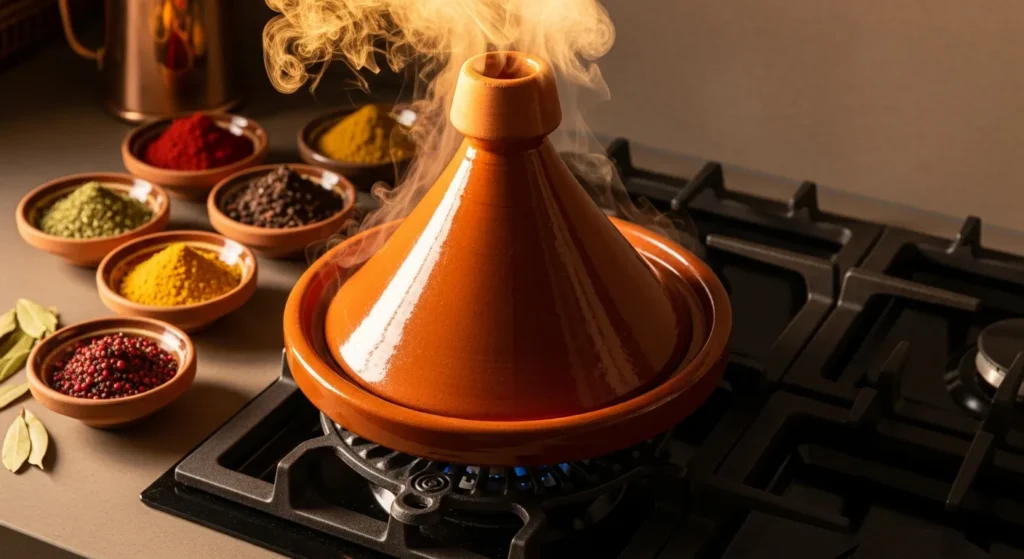
The short answer is yes—you can use a tagine on virtually every heat source in a modern kitchen. But the technique matters enormously. Clay responds to heat differently than metal cookware, and getting this wrong is the fastest way to crack your tagine.
This guide walks you through step-by-step instructions for every stovetop type, explains exactly when and why you need a heat diffuser, covers the ideal temperature settings for each surface, and shows you how to get flawless results whether you’re cooking on gas, electric, ceramic, induction, or in the oven.
Why Heat Source Matters for Tagine Cooking
A tagine cooking vessel is not like a stainless steel pan or cast iron skillet. It’s made from porous clay—a material that absorbs and radiates heat slowly and gently. That’s exactly what makes tagine food so extraordinary: the low, even heat creates a self-basting condensation cycle inside the conical lid that produces intensely concentrated flavors with minimal added liquid.
But clay has a vulnerability: it cannot tolerate rapid or uneven temperature changes. Direct, intense heat from a burner concentrated on a small area of the base can create thermal stress—and that stress leads to cracks.
This is why the type of stove you use, and how you manage the heat, directly determines whether your tagine thrives or fractures. Each heat source distributes energy differently, and your technique must adapt accordingly.
How to Use a Tagine on a Gas Stove
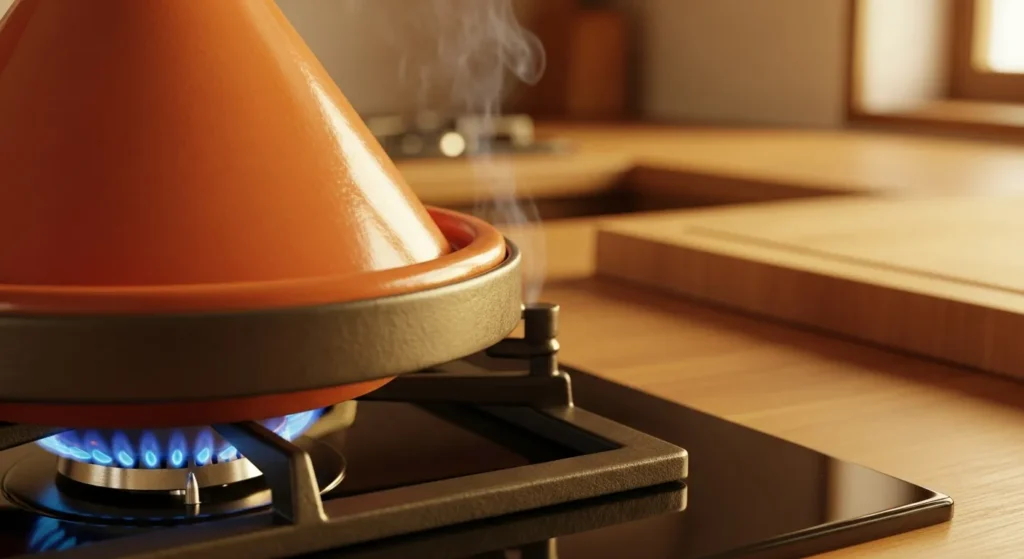
Gas stoves are the closest modern equivalent to the traditional charcoal cooking method that Moroccan cooks have used for centuries. The flame provides responsive, adjustable heat—but it also concentrates that heat in a small ring directly under the tagine’s base.
Step-by-Step: Tagine on Gas Stove
- Always use a heat diffuser. Place a metal or cast iron heat diffuser on the gas burner before setting your tagine on top. This spreads the flame’s concentrated heat across a wider surface area, protecting the clay from hot spots.
- Start cold. Place your loaded tagine (with all ingredients inside) on the diffuser over the unlit burner. Never place a cold tagine over an active flame.
- Light the burner on the lowest setting. Begin with the smallest flame possible. You want the tagine to warm gradually—this takes 10–15 minutes, and that patience is essential.
- Increase to low-medium heat slowly. After the initial warm-up, you can raise the flame slightly. Your target is a gentle simmer, never a rolling boil. You should see occasional wisps of steam escaping from beneath the lid, not a constant plume.
- Maintain low heat for the full cook time. Most tagine dishes cook for 1.5–3 hours. Resist the urge to crank the heat to speed things up—the slow condensation cycle is what builds flavor.
- Never move a hot tagine directly to a cold surface. When cooking is finished, turn off the burner and let the tagine rest on the diffuser for 10–15 minutes before moving it to a trivet or wooden board.
Temperature Guide for Gas
| Phase | Flame Setting | Duration |
|---|---|---|
| Initial warm-up | Lowest possible | 10–15 minutes |
| Active cooking | Low to low-medium | 1.5–3 hours |
| Resting | Off (on diffuser) | 10–15 minutes |
How to Use a Tagine on an Electric Stove
Electric coil stoves present a specific challenge: the heating element produces intense, direct heat from a fixed metal coil. Because the coil makes physical contact with the tagine’s base, the risk of thermal shock is higher than with gas.
Step-by-Step: Tagine on Electric Coil Stove
- A heat diffuser is essential. On electric coil burners, a diffuser isn’t optional—it’s critical. The direct contact between the hot coil and clay creates extreme temperature differentials that will eventually crack unprotected clay.
- Place the diffuser on the cold burner. Set your heat diffuser on the electric element before turning anything on.
- Load your tagine and place it on the diffuser.
- Turn the burner to the lowest setting (1–2 out of 10). Electric coils retain heat and are slow to respond to adjustments. Start lower than you think you need to.
- Wait 15–20 minutes for gradual heating. Electric elements take longer to stabilize than gas, so extend your warm-up phase.
- Increase to setting 3–4 maximum for active cooking. On most electric stoves, this produces the gentle simmer a tagine requires. If the liquid begins to boil vigorously, reduce the heat immediately.
- Be aware of heat lag. When you turn down an electric coil, it stays hot for several minutes. Plan your temperature reductions ahead of time.
- Let the tagine cool on the diffuser with the burner turned off for at least 15 minutes before moving.
Temperature Guide for Electric Coil
| Phase | Dial Setting | Duration |
|---|---|---|
| Initial warm-up | 1–2 / 10 | 15–20 minutes |
| Active cooking | 3–4 / 10 | 1.5–3 hours |
| Resting | Off (on diffuser) | 15+ minutes |
Pro tip: If your electric stove has a “simmer” burner (a smaller element), use it. The reduced size better matches the tagine’s base and provides more proportional heat distribution.
How to Use a Tagine on a Ceramic Cooktop
Ceramic cooktops (smooth-top electric stoves with radiant heating elements under a glass-ceramic surface) are popular in modern kitchens. They work well with tagines, but require attention to a few details.
Step-by-Step: Tagine on Ceramic Cooktop
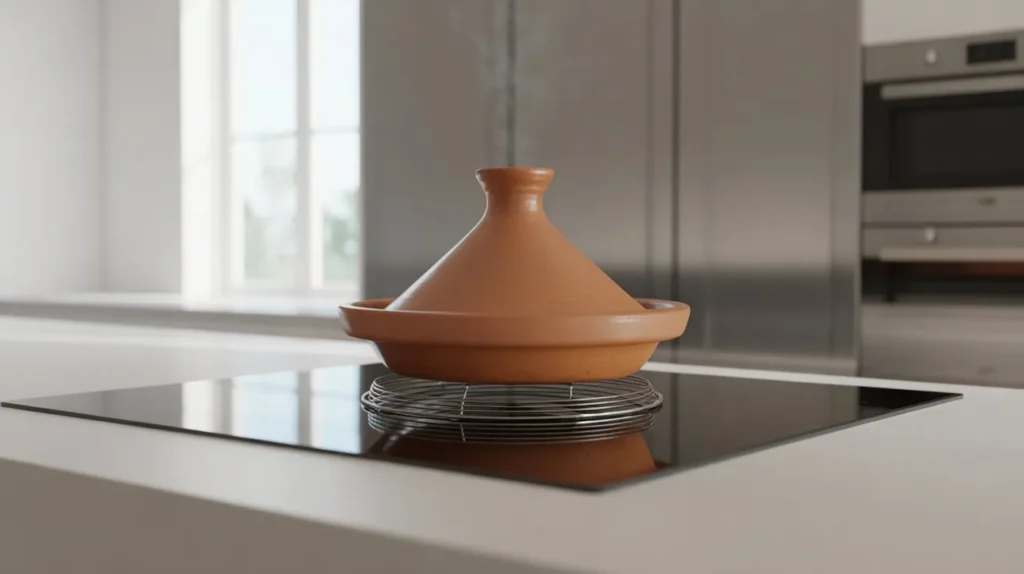
- Use a heat diffuser (recommended). While some ceramic cooktop owners cook with tagines directly on the surface, a diffuser adds an important layer of protection. It slows the heat transfer rate and prevents the clay base from sitting directly on the hot glass, which can cause both thermal shock to the tagine and potential damage to the cooktop surface.
- Check your tagine’s base. Ensure the bottom of your tagine (or diffuser) is completely flat and free of rough edges or debris. Ceramic cooktops scratch easily, and an unglazed clay base can be abrasive.
- Place the diffuser on the cool burner zone. Select a burner that closely matches the diameter of your diffuser.
- Set the tagine on the diffuser and turn the heat to low (2–3 out of 10).
- Warm up gradually over 15 minutes.
- Cook at low to low-medium heat. Ceramic cooktops heat relatively evenly, which is a natural advantage for tagine cooking. Maintain a gentle simmer throughout.
- Avoid sliding the tagine across the surface. Always lift it—never drag—to prevent scratching the glass-ceramic.
- Cool gradually on the burner before moving to a trivet.
Why a Diffuser Helps on Ceramic
Even though ceramic cooktops provide fairly even heat, the surface temperature can spike quickly when the element cycles on. A diffuser moderates these temperature fluctuations, creating the steady, gentle heat that clay responds to best.
How to Use a Tagine on a Glass Top Stove
Glass top stoves and ceramic cooktops are often used interchangeably in conversation, but the important takeaway is the same: protect both the tagine and the stove surface.
Key Precautions for Glass Top Stove Use
- Always use a heat diffuser to buffer between the clay base and the glass surface
- Never drag the tagine across the glass—always lift
- Match burner size to diffuser size for even heat distribution
- Start on the lowest setting and increase slowly
- Avoid placing a hot tagine on a cold section of the glass top
The cooking process follows the same sequence as the ceramic cooktop method above. The diffuser is your most important tool here—it protects the clay from sudden temperature spikes and prevents the rough clay base from scratching or cracking the glass surface.
How to Use a Tagine on an Induction Hob
Induction hobs are the most challenging heat source for traditional clay tagines. Here’s why: induction cooktops work by generating a magnetic field that heats ferromagnetic cookware directly. Clay is not magnetic—so a standard clay tagine placed on an induction hob simply won’t heat at all.
But that doesn’t mean induction users are out of luck.
Solutions for Induction Hob Users
Option 1: Use an Induction-Compatible Heat Diffuser
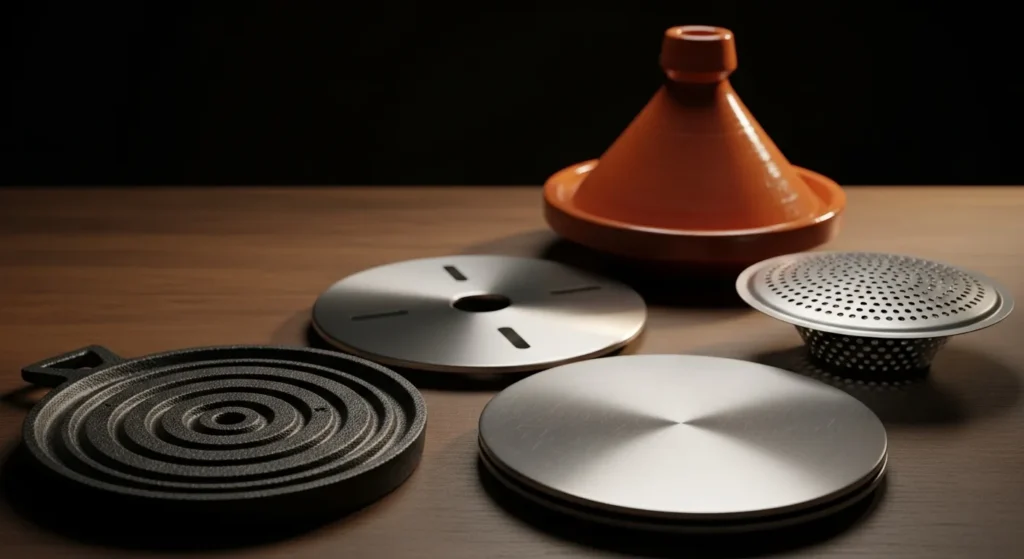
This is the most practical solution. An induction-compatible diffuser (sometimes called an induction adapter plate or converter disc) is a flat disc made from ferromagnetic metal (usually stainless steel with a magnetic base). It works by converting the magnetic energy from the induction hob into radiant heat, which then transfers to the clay tagine above it.
Steps:
- Place the induction diffuser disc on the induction zone
- Set your loaded tagine on top of the diffuser
- Turn the induction hob to a low setting (around 3–4 out of 10, or approximately 200–250 watts if your hob shows wattage)
- Allow 15–20 minutes for gradual heating through the diffuser
- Cook at a low simmer for the full duration
- Note: there will be more heat lag than direct induction cooking, so adjust temperature changes earlier than you normally would
Option 2: Use a Cast Iron Tagine
Some manufacturers produce tagines with cast iron bases specifically designed for induction compatibility. These work directly on an induction hob without a diffuser. However, they sacrifice the porous clay’s unique flavor-building properties and the traditional cooking experience.
Option 3: Cook in the Oven Instead
If your kitchen only has an induction hob and you don’t want to purchase a diffuser, oven cooking is an excellent alternative that produces authentic results. We cover this method in detail below.
Temperature Guide for Induction (with Diffuser)
| Phase | Power Setting | Duration |
|---|---|---|
| Initial warm-up | 2–3 / 10 (~150–200W) | 15–20 minutes |
| Active cooking | 3–4 / 10 (~200–300W) | 1.5–3 hours |
| Resting | Off (on diffuser) | 15+ minutes |
Your Complete Tagine Heat Diffuser Guide
By now, you’ve noticed a pattern: nearly every heat source works better—and safer—with a heat diffuser beneath your tagine. Understanding whether you need a heat diffuser is one of the most important steps in tagine cooking. Here’s a comprehensive breakdown of when to use one and what to look for.
When You Need a Heat Diffuser
| Heat Source | Diffuser Required? | Why |
|---|---|---|
| Gas stove | Yes | Flame concentrates heat in a small ring |
| Electric coil | Yes | Direct coil contact creates extreme hot spots |
| Ceramic cooktop | Recommended | Moderates temperature cycling |
| Glass top stove | Yes | Protects both tagine and glass surface |
| Induction hob | Yes (induction-compatible) | Clay is non-magnetic; diffuser converts energy |
| Oven | No | Oven provides even, ambient heat from all sides |
| Charcoal / open fire | Optional | Traditional method; clay handles it well with experience |
What to Look for in a Heat Diffuser
- Material: Cast iron or heavy-gauge steel. These retain heat well and distribute it evenly
- Size: Should match or slightly exceed the diameter of your tagine’s base (typically 8–10 inches)
- Induction compatibility: If you cook on induction, ensure the diffuser has a ferromagnetic base
- Flat, stable surface: The diffuser must sit level on your burner and provide a stable platform for the tagine
- Heat handle or knob: Useful for repositioning the hot diffuser safely
A quality heat diffuser is an inexpensive investment—typically $10–$25—that dramatically extends the life of your tagine and gives you confidence on any stovetop.
How to Use a Tagine in the Oven vs Stovetop
Many home cooks don’t realize that oven cooking is one of the best methods for tagine dishes—and in some ways, it’s even more forgiving than the stovetop.
Why the Oven Works So Well
The oven surrounds your tagine with gentle, ambient heat from all directions. There are no hot spots, no concentrated flame, no direct contact with a heating element. This is the closest approximation to the even, low heat of a traditional Moroccan charcoal brazier—and it eliminates the need for a heat diffuser entirely.
Step-by-Step: Tagine in the Oven
- Prepare your dish in the tagine on the countertop. Layer your protein, vegetables, Moroccan spices, and a small amount of liquid directly in the tagine base.
- Place the loaded tagine into a cold oven. This is critical—never put a clay tagine into a preheated oven. The sudden temperature shock will crack the clay.
- Set the oven temperature to 300–325°F (150–160°C). The tagine heats gradually along with the oven, eliminating thermal stress.
- Cook for 2–3 hours without lifting the lid. The conical lid’s condensation cycle will keep everything moist and intensely flavorful. Trust the process.
- Turn off the oven and let the tagine rest inside for 15–20 minutes. This gradual cool-down protects the clay and allows the flavors to settle.
- Remove carefully with oven mitts and place on a wooden board or thick trivet—never on a cold stone countertop or metal surface.
Oven vs Stovetop: Which Is Better?
| Factor | Oven | Stovetop |
|---|---|---|
| Heat distribution | Even from all sides | Concentrated from below |
| Diffuser needed | No | Yes (on most stoves) |
| Temperature control | Set-and-forget | Requires monitoring |
| Browning/searing first | Not easily | Possible (with care) |
| Best for beginners | ✔ | Requires more experience |
| Condensation cycle | Excellent | Excellent |
| Traditional experience | Less hands-on | More authentic feel |
The bottom line: If you’re new to tagine cooking, start in the oven. It’s virtually foolproof. As you gain confidence, move to stovetop cooking for more control and the satisfying ritual of tending a slow-simmering tagine.
For a deeper comparison of how the tagine performs against other slow-cooking vessels, our guide to tagine vs Dutch oven vs slow cooker breaks down the strengths of each method.
Quick-Reference: Temperature Settings Across All Heat Sources
| Heat Source | Warm-Up Setting | Cooking Setting | Diffuser? | Estimated Cook Time |
|---|---|---|---|---|
| Gas stove | Lowest flame | Low to low-medium | Yes | 1.5–3 hours |
| Electric coil | 1–2 / 10 | 3–4 / 10 | Yes | 1.5–3 hours |
| Ceramic cooktop | 2–3 / 10 | 3–4 / 10 | Recommended | 1.5–3 hours |
| Glass top stove | 2–3 / 10 | 3–4 / 10 | Yes | 1.5–3 hours |
| Induction hob | 2–3 / 10 (~150W) | 3–4 / 10 (~250W) | Yes (induction type) | 1.5–3 hours |
| Oven | Cold start → 300°F | 300–325°F (150–160°C) | No | 2–3 hours |
Common Mistakes That Crack Your Tagine
Even experienced cooks can damage a tagine by ignoring one of these rules. Save yourself the heartbreak:
- Preheating without the tagine on the burner. Always start from cold—tagine and heat source should warm up together
- Skipping the heat diffuser. On gas, electric, ceramic, and glass stoves, this is non-negotiable for clay tagines
- Using high heat. Tagines are designed for low and slow cooking. High heat doesn’t speed things up—it destroys the pot
- Placing a hot tagine on a cold surface. Thermal shock works both ways. Always use a trivet or wooden board
- Adding cold liquid to a hot tagine. If you need to add liquid mid-cook, warm it first
- Using a chipped or cracked tagine on direct heat. If your tagine shows damage, retire it to oven-only use or re-season it and assess the damage
For a deeper dive into what causes cracks and how to prevent them, read our tagine crack prevention guide.
Choosing the Right Tagine for Your Kitchen
Your stove type can influence which tagine works best for you. Here’s a practical framework:
For Gas and Electric Stove Owners
Any traditional clay tagine will work beautifully with a heat diffuser. The Eco Moroccan Clay Tagine Set is an excellent starting point—handcrafted using the traditional FRAN ALI method, chemical-free, and available in sizes for 1 to 4 people.
For Ceramic and Glass Top Stove Owners
Choose a tagine with a smooth, glazed base to minimize the risk of scratching your cooktop. The Contemporary Moroccan Cooking Tagine for Two offers a modern glazed finish that pairs well with sleek kitchen surfaces—always used with a diffuser underneath.
For Induction Hob Owners
Pair any clay tagine with an induction-compatible diffuser disc, or consider a cast iron tagine for direct induction use. If you prefer the authentic clay experience, the diffuser route is simpler and preserves the traditional cooking benefits that make tagine food special.
For Oven-Only Cooks
Any cooking tagine works in the oven. This is the most forgiving method, so it’s ideal for first-time tagine users who want to build confidence before experimenting on the stovetop.
Start Cooking: Your Next Step
Now that you know how to use a tagine on every heat source in your kitchen, the only thing left is to cook. If you’re looking for inspiration, our collection of tagine recipes covers everything from classic lamb tagine with dried figs and almonds to lighter fish tagine with preserved lemons.
And if you haven’t yet chosen your tagine, browse our handcrafted cooking tagines—each one made by Moroccan artisans using techniques passed down through generations. With the right tagine, the right technique, and a little patience, every heat source in your kitchen becomes a gateway to authentic Moroccan flavor.
Ready to bring Morocco to your table? Explore our cooking tagine collection and start your first slow-cooked masterpiece.